 Available 24 Hours a Day, 7 Days A Week
  027 424 0600

Speed Humps Timaru

Available 24 Hours a Day, 7 Days A Week

100% Client Satisfaction

Full Range of Premier Services

High-Quality Products
Get A Free Quote

Ask about speed humps in Timaru and the first thing worth knowing is that nobody installs one because you asked. A hump is a raised profile across a lane that makes crossing at speed uncomfortable, used on residential streets, at crossing points and inside private car parks, yards and service lanes. On a public road, Timaru District Council decides, and it assesses requests on traffic and safety data rather than on the request alone. On land you own, the decision is yours alone and there is no process to go through. Group One New Zealand designs, manufactures and installs traffic calming, with crews running down State Highway 1 from a base on Foremans Road in Islington, Christchurch. Sydney Chappell founded the New Zealand company in 2026.
How a request works on a Timaru street
If vehicles are speeding on your street, the council is the place to report it. A Road Safety Coordinator reviews the traffic data already held for that road, or arranges new speed surveys, and the decision follows the numbers. That is genuinely more useful than it sounds: a survey can show the problem is a handful of vehicles at one time of day, which a hump is a heavy answer to.
Timaru District Council is also plain about where humps do not belong. They are generally avoided on roads carrying high traffic volumes, on bus routes and where heavy trucks make up a significant share of traffic, because of the noise they generate and the effect on traffic flow. In a town built around a port, that rules out a fair few streets.
Call 027 424 0600 to Request a Free Quote
Industries We Serve
We proudly serve clients across a range of sectors, including:

Hospitals

Aviation Surfaces

Schools

Sporting Surfaces

Factory Safety Lines

Body Corporate
Public street, private yard
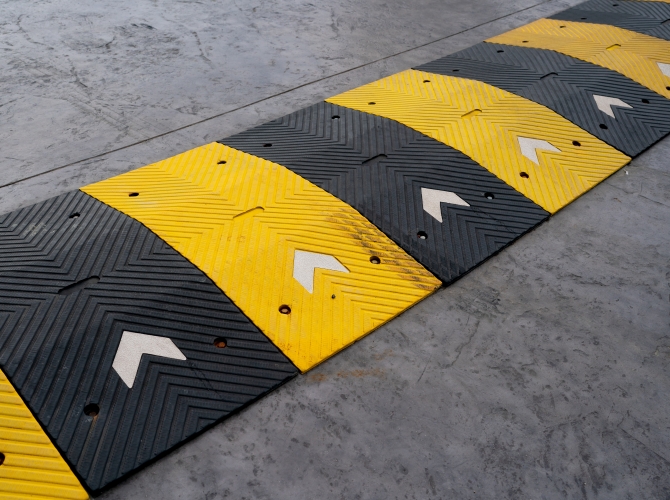
The boundary does the sorting. Out on the street the road belongs to Timaru District Council, and a hump there follows survey data, budgets and a programme you do not control. Behind your gate the answer is different. A car park, a loading yard, a service lane, an internal road through a body corporate or a retirement village: the owner decides whether a hump goes in, exactly where, and what it is made from. No consent, no survey, no waiting for a programme. Most people asking this question already own the surface that is bothering them.
When a hump is the wrong tool
Even the council treats placement as something to test rather than assume. In February 2023 temporary speed humps went into Timaru’s main street alongside a lowered speed limit, as a trial to make the area more attractive. Temporary, and a trial: that is the honest posture with any calming device.
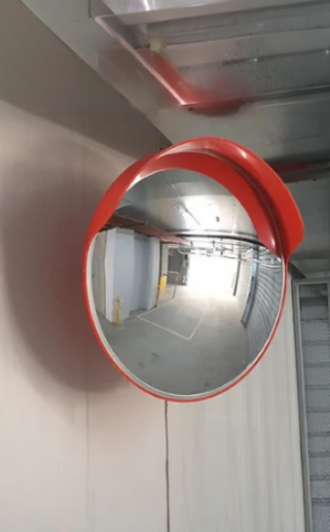
On a private site the same logic applies. If your problem is one delivery driver taking a corner too fast, a hump across the whole aisle punishes every other vehicle to fix one. Signage, marking, a mirror at the blind corner, or moving where vehicles enter can be the better answer, and we will say so on site rather than sell you six units you do not need.
Choosing the device for what crosses it
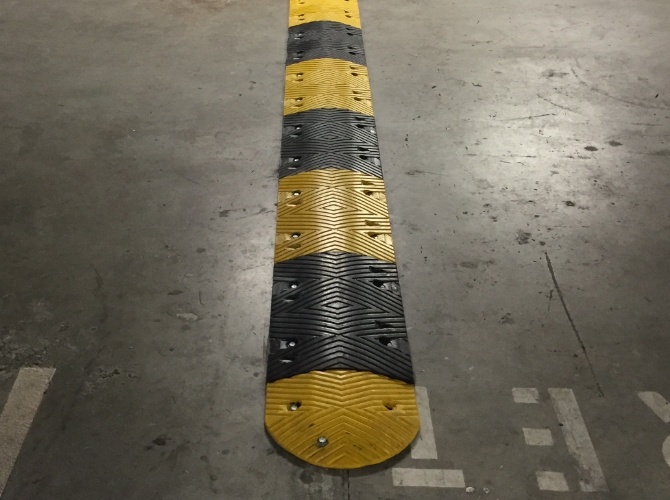
- Full-width humps for car park aisles and entrance approaches where everything should slow.
- Speed cushions where wide-axle trucks need to straddle, so the fleet is not taking a hit on every pass.
- Raised tables and raised pedestrian crossings where people cross on foot between buildings.
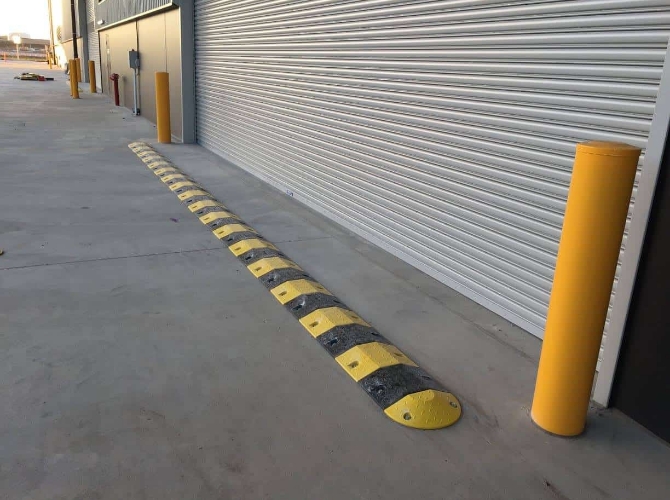
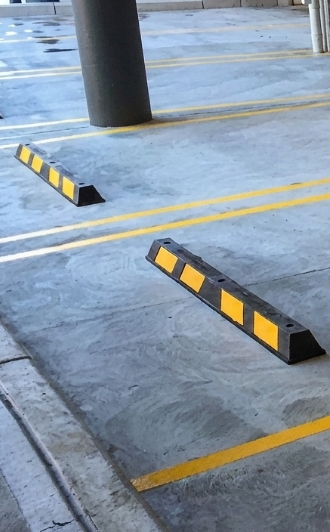
- Modular rubber and bolt-down units on sound asphalt or concrete, when you do not want to reform the pavement.
- Deployable and temporary units for events, works and seasonal traffic.
- Asphalt or concrete profiles formed in place where the surface is being reworked anyway.
Salt air makes the fixings a specification, not an afterthought
Airborne sea salt on this coast accelerates corrosion of construction metals, which is why local work leans on hot-dip galvanised and powder-coated steel. A bolt-down hump is only as good as what holds it to the slab, and fasteners that would last inland do not last on an exposed yard a short drive from the water. Fixings, coatings and the finish on any steel component are part of the design conversation here, not a detail we sort out on the day.
Need Professional Line Marking or Safety Products?
Contact Group One today – reliable, accredited, and available 24/7.

Client Testimonials


5.0 Stars / 21 + reviews
The team from Group One were exceptional.
They arrived on time, did a fantastic job and made our childcare centre carpark look like new . Thankyou
Prompt and efficient service.
Very professional and experienced. Syd always answers his phone otherwise calls you back. Highly recommended.
Highly recommended.
Competitive price, quality work and even helped me put up the customer parking signs. Went above and beyond. Thanks very much, Syd and Blake.
Great job and no complaints!
Wonderful to work with and helping us get our line marking completed. Would definitely use again and refer to others.
Highly Recommend Group 1 Linemarking!
We recently hired Group 1 Linemarking for a few of our residential strata projects, and the results exceeded our expectations. The team was punctual, professional, and clearly experienced. The line marking was crisp, precise, and done exactly to spec. Communication throughout the process was smooth, and they were flexible with scheduling, which made things a lot easier on our end. If you need reliable, high-quality line marking services, I wouldn’t hesitate to recommend Group 1. Great job!
Working with Syd and his team is always a pleasure
The quality of work is always to a high standard. The Group One team is always professional, they apply a high standard for safety ensuring their SWMS is tailored for the job and their equipment is serviced and well maintained. I highly recommend Group One and if you use them you won’t be disappointed.
The sites this matters on around Timaru
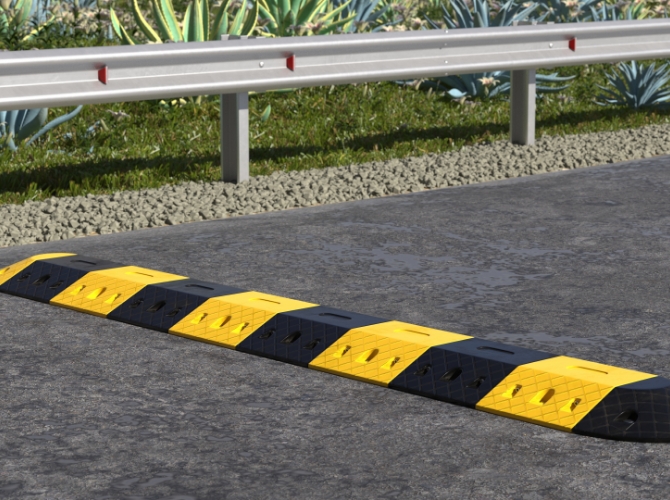
Timaru is the industry hub for South Canterbury, with PrimePort handling around $1.1 billion in exports a year and meat, dairy, food processing, engineering and logistics operators concentrated around the port and out at Washdyke, where the state highways meet. Those are yards where a truck turning in crosses a route people walk, and where the vehicle mix rules out anything that punishes a loaded unit.
Beyond the industrial belt, the calls come from retail and hospitality forecourts, school and early learning grounds, rest homes and retirement villages, and rural and lifestyle block entrances across the district. Where those entrances run , the device usually belongs past the point vehicles queue rather than in front of it.
What a quote is built from, and how the job runs
Everything is on quote. The number moves on which device and how many, the surface it fixes into or is formed onto, access and when we can have the area, the traffic volumes and vehicle types crossing it, drainage, the marking and signage around it, and any reinstatement afterwards.
The work runs as design, manufacture and installation. Design starts with a site visit and a measure-up, watching where speed actually builds. Manufacture covers the units or profiles for that layout. Installation includes the fixings, making the surface good and marking the hump so a driver sees it in time.
Call 027 424 0600 to Request a Free Quote




Group One New Zealand, and the run south
Timaru is the southern limit of the area the crews reach, driving down from Islington in Christchurch. On a port or Washdyke site the argument is as much about fixings and finish as about which device goes in, and a small team can usually settle that in one visit rather than three. Group One New Zealand was founded by Sydney Chappell in 2026. Nothing on a public street runs through us. A request there goes to Timaru District Council and its road safety coordinator, who assesses it on traffic and safety data. Where a longer history is claimed, it is claimed for Australia: “Although Group 1 Line Marking has just started here in New Zealand, as a group we have been operating in Australia for almost 25 years.” The page has the full list.
Three things to have ready
Before we come out, it helps to know the surface you are working with, the heaviest vehicle that will cross the hump, and how exposed the site is to the coast. Those three answers shape the device, the fixings and the finish, and they are the difference between a unit that lasts and one that works loose in its second winter.
Phone us on 027 424 0600 or email info@groupone.co.nz, 7am to 3pm Monday to Friday. Group One New Zealand, Unit 1, 37 Foremans Road, Islington, Christchurch 8042. NZBN 9429053752833.
Call 027 424 0600 to Request a Free Quote
Comprehensive Line Marking & Safety Services
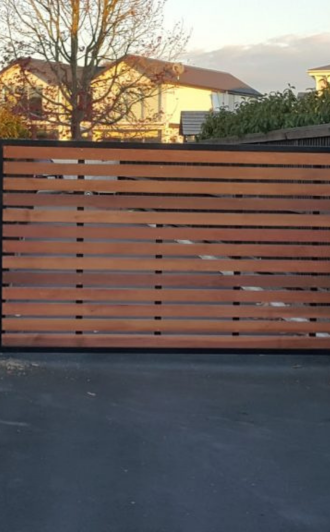
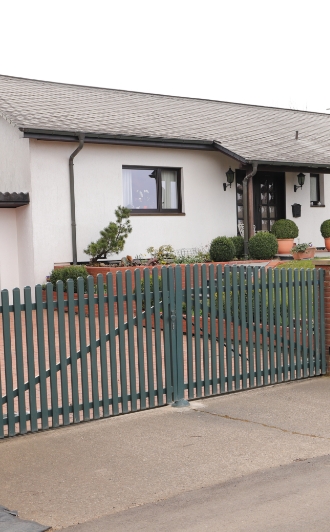
Safety and Palisade Fencing
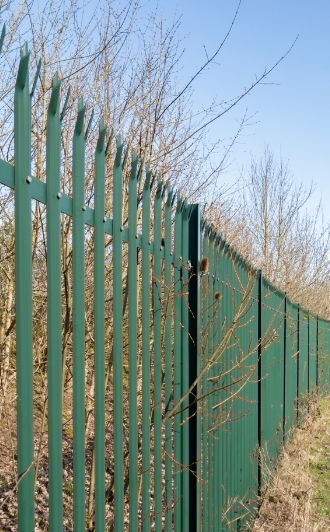
Safety and palisade fencing is the steel perimeter that goes...
More Details
Areas We Serve
- Speed Humps Amberley
- Speed Humps Ashburton
- Speed Humps Christchurch
- Speed Humps Darfield
- Speed Humps Kaiapoi
- Speed Humps Methven
- Speed Humps Rangiora
- Speed Humps Rolleston
- Speed Humps Timaru
Other Services Available in Timaru
Questions we get from South Canterbury sites
What are speed bumps called in New Zealand?
Judder bars is the local name, and it covers humps, bumps and the rest of the family.
What is the difference between a speed bump and a hump?
The words get used interchangeably. Where a distinction is drawn, a bump is short and abrupt, the sort you meet in a car park, and a hump is longer and gentler. Neither is a technical specification, so the profile you pick should follow the vehicles, not the vocabulary.
What speed should I go over one?
The road’s posted limit still applies. The device is shaped so that anything faster than it was designed for feels wrong, which is the entire mechanism.
What are the alternatives?
A lower speed limit, better marking and signage, a raised crossing at the point people actually walk, a mirror at a blind corner, or changing where vehicles enter and exit. On the public road the council weighs these first, and so should you on your own site.
Do speed bumps ruin your tyres?
Crossed at the intended speed, no. Taken hard, or laid with the wrong profile for a heavy fleet, they are rough on tyres and suspension both.
Will one survive a Washdyke yard?
That depends on the fixings and the axle loads, which is why we ask about the heaviest vehicle before quoting rather than after.
Get Started with Professional Line Marking Solutions

Get a Free Consultation
Speak with our experts to discuss your line marking requirements and get a tailored solution.
Schedule Now
Need Help Choosing?
Our team provides advice on the right line marking services and materials for your site.
Find Your Solution
Talk to an Expert
Have questions or want a quote? Connect with our experienced team today.
Contact Us