 Available 24 Hours a Day, 7 Days A Week
  027 424 0600
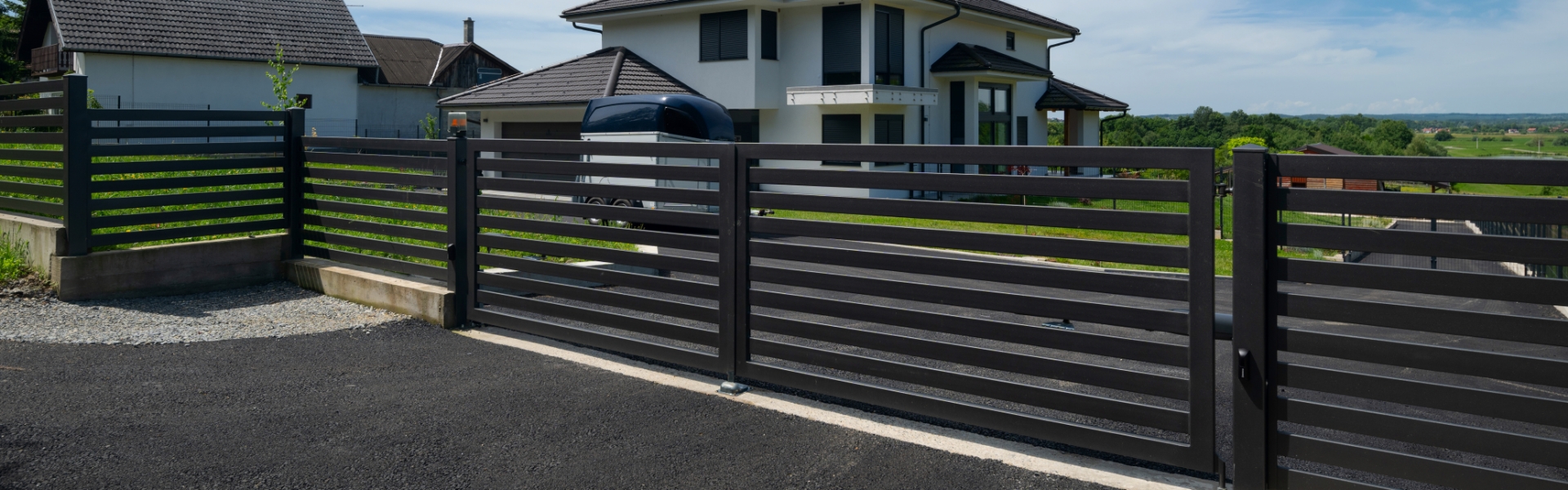
Driveway Gates Methven

Available 24 Hours a Day, 7 Days A Week

100% Client Satisfaction

Full Range of Premier Services

High-Quality Products
Get A Free Quote

The gate has to open for a cleaner at ten while you are in another city. That is the brief behind a fair share of the driveway gates we build in Methven, where the short-stay pool runs to dozens of holiday homes, apartments, lodges, farm stays and backpacker accommodation, and the person arriving is rarely the person who owns the place. Group One New Zealand designs, manufactures and installs gates through mid-Canterbury, with crews travelling out from a base on Foremans Road in Islington, Christchurch.
Letting people in when you are not there
Access is the part of this decision most worth getting right, because it is the part you will use every week.
- Keypad. A code at the gate, changeable between guests. Simple, needs no app and no phone signal, and works for anyone who can read a booking email.
- Remotes. Best for the people who come regularly: you, a manager, a contractor. Easy to hand over, easy to lose.
- Bluetooth or mobile. Opens from a phone within range, which suits an owner or manager arriving in their own vehicle.
- SIM-based control. The unit takes a call or a message, so the gate can be opened for someone from anywhere. This is the one that solves the guest who arrives early, the plumber you cannot meet, and the cleaner between changeovers.
Safety devices are not optional on any of them. A gate that closes automatically needs the sensing gear that stops it on an obstruction, particularly where drivers do not know the entrance. Alternative opening methods and those same safety devices are what allow automatic gates on sloped ground as well as flat-level ground, and a manual release matters here too: if the power goes out mid-winter, someone has to be able to open the gate by hand.
Already have a gate that suits the property? We supply parts, hardware, access controllers and remote locks, so adding automation and remote access to an existing gate is often the quicker path.
Call 027 424 0600 to Request a Free Quote
Industries We Serve
We proudly serve clients across a range of sectors, including:

Hospitals

Aviation Surfaces

Schools

Sporting Surfaces

Factory Safety Lines

Body Corporate

An entrance that has to work through a cold season
Methven sits at about 320 metres, close to the foothills of the Southern Alps, and township forecasts through winter record overnight temperatures falling below freezing with rain turning to snow. That shapes three things.
Footings go deep enough to sit below ground movement, because a post that shifts through a freeze-thaw cycle takes the gate’s alignment with it. Ground clearance under the leaf is set with a frozen or built-up surface in mind, so the gate is not scraping through the first cold snap. And on a slider, the track and its run-back need to shed water and stay clear, since ice in a track stops a gate as effectively as a lock.
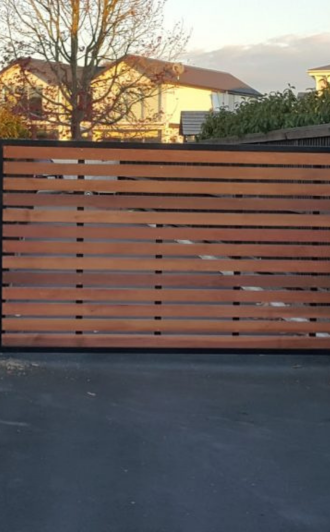
Our range of materials covers wood, steel, aluminium and stainless steel. Steel handles wide rural spans and should be hot-dip galvanised before powder-coating, so the protection sits inside the sections as well as on the surface. Aluminium is light and needs very little upkeep. Timber suits a lodge or a house it can be matched to, with a frame built to stay square. Stainless steel goes into fixings and fittings that have to keep working. A solid infill catches the wind that comes off the ranges; slatted or spaced infill lets it through.
Swing or slide at your entrance
The measurements come first: the opening span between posts, the fall of the ground, and the longest vehicle that uses it. A guest with a rental van, a shuttle, a horse float or a farm vehicle all ask for different clear widths.
A single swing leaf needs clear arc across the whole opening. A double pair halves that per leaf and gives a wide clear opening for a rural entrance. A sliding gate needs no arc but wants a level run alongside the driveway roughly as long as the opening, on ground kept clear year-round. Where the driveway rises away from the road, the swing leaf climbs as it opens and must be hung to clear its high point, so a slider often reads better. Leaves that open inward keep the road clear, which matters more where drivers are unfamiliar and speeds through the township have been reduced for exactly that reason.
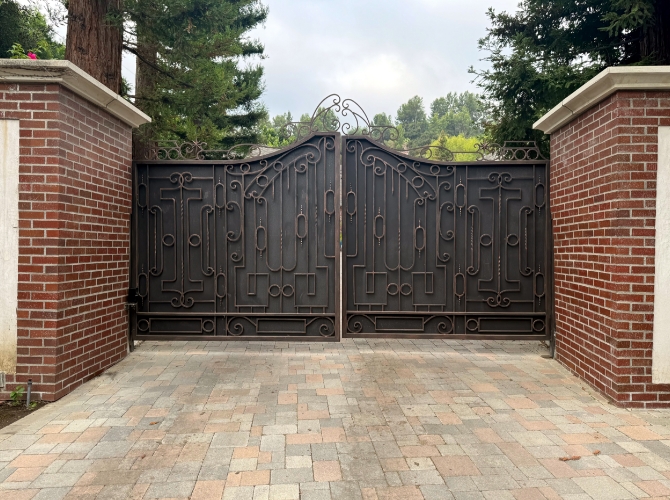
The Ashburton District Council rules that apply here
Methven sits in the Ashburton District, so the Council’s fencing position governs. You can build a fence up to 2.5 metres in height from the natural ground level. Above 2 metres, the Council recommends talking to its Planning Department about whether a resource consent is required, and a gate on the road boundary is the case most likely to raise that question.
If the gate or fence sits on top of a retaining wall, a building consent is required where the retaining wall is more than 1.5 metres high and the fence more than 2.5 metres high. Where the fence and the retaining wall are joined, a Building Consent is required. Swimming pool and spa fencing is regulated separately and is never covered by a general exemption. Where the gate meets a shared boundary, the Fencing Act 1978 sets out what you and your neighbour each owe. Confirm the current requirements with Ashburton District Council before work starts.
Design, manufacture, installation
Design happens on site, with the span, the fall, the surface, the vehicles and the access requirements all settled at the entrance. Manufacture is to those measurements. Installation covers the post holes, footings, hanging, automation and testing, including running the access hardware through with you before the crew leaves. All our gates are 100% New Zealand made and installed, and they carry a comprehensive warranty backed by a full after-sales service.
Need Professional Line Marking or Safety Products?
Contact Group One today – reliable, accredited, and available 24/7.

Client Testimonials


5.0 Stars / 21 + reviews
The team from Group One were exceptional.
They arrived on time, did a fantastic job and made our childcare centre carpark look like new . Thankyou
Prompt and efficient service.
Very professional and experienced. Syd always answers his phone otherwise calls you back. Highly recommended.
Highly recommended.
Competitive price, quality work and even helped me put up the customer parking signs. Went above and beyond. Thanks very much, Syd and Blake.
Great job and no complaints!
Wonderful to work with and helping us get our line marking completed. Would definitely use again and refer to others.
Highly Recommend Group 1 Linemarking!
We recently hired Group 1 Linemarking for a few of our residential strata projects, and the results exceeded our expectations. The team was punctual, professional, and clearly experienced. The line marking was crisp, precise, and done exactly to spec. Communication throughout the process was smooth, and they were flexible with scheduling, which made things a lot easier on our end. If you need reliable, high-quality line marking services, I wouldn’t hesitate to recommend Group 1. Great job!
Working with Syd and his team is always a pleasure
The quality of work is always to a high standard. The Group One team is always professional, they apply a high standard for safety ensuring their SWMS is tailored for the job and their equipment is serviced and well maintained. I highly recommend Group One and if you use them you won’t be disappointed.
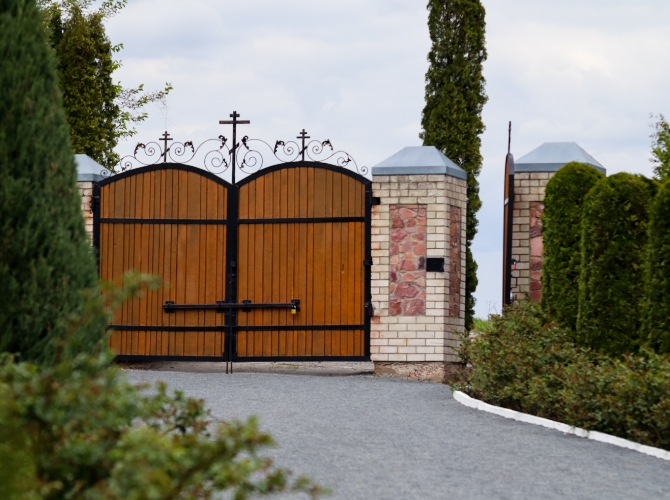
Costing an entrance at 320 metres
Pricing is on quote, and two of the inputs are worth more of the number here than they would be down on the flat. Footings are the first: a post set below winter ground movement is a deeper hole and more concrete, and where a slider is going in, the run-back wants a surface that sheds water instead of holding it until it freezes. Access hardware is the second, because an entrance that has to let guests, cleaners and a property manager through needs a controller able to issue and cancel credentials one at a time, which is a heavier specification than a pair of remotes.
The rest is priced the way it would be anywhere: opening span and configuration, leaf weight, style and infill, material and finish, the driveway surface and what the posts go into, safety devices, whether the supply at the gate is mains or solar, and the trip inland.
Group One New Zealand, for an owner who is somewhere else
A good share of the Methven work in front of us is commissioned by someone who will not be standing at the entrance when the crew arrives. That puts weight on being able to get hold of the people who did the job, and there is not much company here to get lost in: Sydney Chappell founded Group One New Zealand in 2026, and it remains a small team that draws, builds and installs its own gates. In the company’s own words: “Although Group 1 Line Marking has just started here in New Zealand, as a group we have been operating in Australia for almost 25 years.” The full range is on our page.
Call 027 424 0600 to Request a Free Quote





Get a quote for the entrance
Think about who will hold what before we specify the hardware: guests on a code you can change, your manager and your regular contractors on their own remotes, and a way to take access back when someone stops working on the place. That decision shapes the controller we fit, so it is worth making before the gate is built rather than after.
Phone us on 027 424 0600 or email info@groupone.co.nz, 7am to 3pm Monday to Friday. Group One New Zealand, Unit 1, 37 Foremans Road, Islington, Christchurch 8042. NZBN 9429053752833.
Call 027 424 0600 to Request a Free Quote
Comprehensive Line Marking & Safety Services
Safety and Palisade Fencing
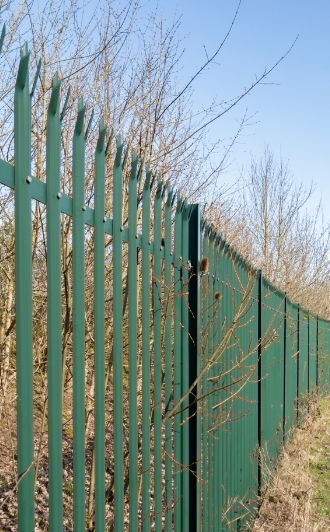
Safety and palisade fencing is the steel perimeter that goes...
More Details
Areas We Serve
- Driveway Gates Amberley
- Driveway Gates Ashburton
- Driveway Gates Christchurch
- Driveway Gates Darfield
- Driveway Gates Kaiapoi
- Driveway Gates Methven
- Driveway Gates Rangiora
- Driveway Gates Rolleston
- Driveway Gates Timaru
Other Services Available in Methven
Questions from Methven owners and managers
What do driveway gates cost here?
Quoted per property. Span, leaf weight, material, finish, ground conditions, automation and the run inland all feed in, so we measure first.
Can the gate run on solar at a property that sits empty?
Yes, and solar suits an entrance well away from the house. The panel and battery are sized for the cycle count, so tell us how often the gate will actually be used across the year.
Will a steel gate rust up here?
Not if it is hot-dip galvanised before it is powder-coated. That combination is what makes steel a long-term answer in a cold, wet season.
Can a property manager be given their own access?
Yes. Keypad codes, remotes and SIM-based control can all be issued separately, so different people can hold different access.
Get Started with Professional Line Marking Solutions

Get a Free Consultation
Speak with our experts to discuss your line marking requirements and get a tailored solution.
Schedule Now
Need Help Choosing?
Our team provides advice on the right line marking services and materials for your site.
Find Your Solution
Talk to an Expert
Have questions or want a quote? Connect with our experienced team today.
Contact Us