 Available 24 Hours a Day, 7 Days A Week
  027 424 0600

Security Gates Darfield

Available 24 Hours a Day, 7 Days A Week

100% Client Satisfaction

Full Range of Premier Services

High-Quality Products
Get A Free Quote

Pull out of a rural entrance onto a Canterbury Plains road and you want to see what is coming well before your bonnet does. That single fact rules out more designs than any council rule, and it is where most conversations about security gates in Darfield start. Group One New Zealand designs, manufactures and installs them across the Selwyn district, with crews travelling the 35 km west from Islington in Christchurch. Sydney Chappell started the New Zealand company in 2026. Phone us on 027 424 0600, 7am to 3pm Monday to Friday, and we will come out and stand at the entrance with you.
This page is about a gate you can touch
A security gate here means a fabricated leaf hung at the entrance to a property in Canterbury, New Zealand: a farm race, a lifestyle-block driveway, a yard, a rural-commercial frontage. It is built from steel, aluminium or timber, hung on posts set into the ground, and it swings or slides. It is not a retail security door or a window grille, which is a separate trade. It is not the release gate that software teams run in a build pipeline, which shares the words and nothing else. Every gate described here is fabricated in New Zealand and installed on a Canterbury site by the crew that made it.
Call 027 424 0600 to Request a Free Quote
Industries We Serve
We proudly serve clients across a range of sectors, including:

Hospitals

Aviation Surfaces

Schools

Sporting Surfaces

Factory Safety Lines

Body Corporate

Height, visibility and Selwyn’s fencing rules
The Selwyn District Plan carries specific urban fencing rules, Rules 4.13 and 4.17, covering height and visibility. Height is the number people expect. Visibility is the one that catches them out, because a rule about being able to see through a structure lands squarely on the gate, which is usually the tallest and most solid thing on the frontage.
Alongside that, the Council advises that any fence more than 2 metres tall will require a building consent and may require a resource consent, and it lists fences or walls higher than 2.5 metres, plus all swimming pools and their associated fences, as needing a building consent. The Council also notes that construction and maintenance of boundary fences is generally governed by the Fencing Act and outside its jurisdiction, so a shared line is a conversation with your neighbour rather than with the Council. Confirm what applies at your address with Selwyn District Council before the job is priced or started.
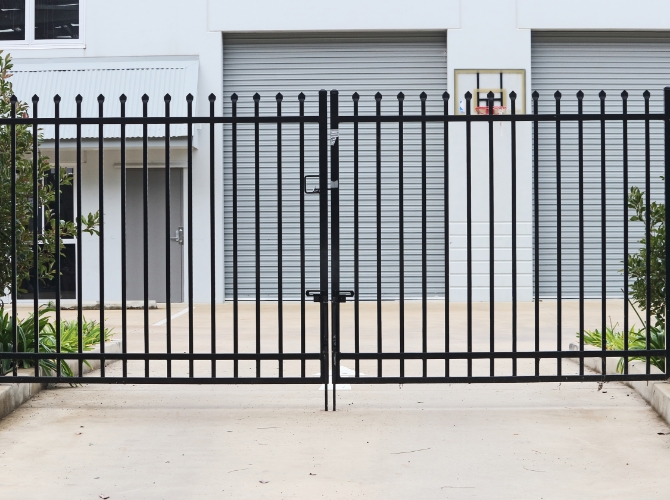
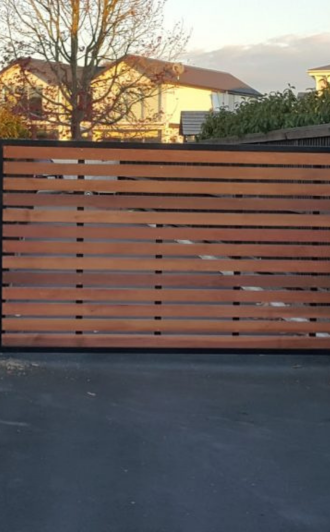
On a rural entrance the visibility question is also a driving one. A tall solid leaf hard on the road boundary blocks the view both ways while you wait for the gate to clear, and it hides you from a vehicle travelling at open-road speed. Vertical bar, palisade and slatted profiles give you a gate that is difficult to climb and still lets you and the driver see each other. Where privacy matters, the usual answer is solid infill on the lower portion of the leaf and an open profile above eye height.
The nor’west arch, and what it does to a leaf
Darfield sits at about 193 metres on the plains and is known as the township under the nor’west arch. Several days a year the dry Foehn wind comes through and can lift the temperature by several degrees in an hour, and winter brings cold blasts off the Southern Ocean the other way.
A gate feels both. Wind load on a solid leaf goes through the hinges into the post and its footing, which is the argument for a ventilated profile on an exposed gateway. The temperature swing is the quieter one: metal moves, and a long leaf that was set with tight clearances on a still, cold morning can bind on a hot nor’west afternoon. Clearances, latch throw and drop-bolt sockets are set with that movement allowed for.
Swing, slide or cantilever on a rural gateway
Form follows the ground. A swing gate is the simplest hardware and needs a clear arc over ground that stays level through the whole travel. A slider on a ground track avoids the arc but needs run-back space and a track that stays clean, which a gravel or stock entrance will not oblige. A cantilever slider carries the leaf clear of the ground with no track at all, and on rural gateways it is often the one that lasts. A bi-fold covers openings with neither arc room nor run-back.
Width comes from what actually uses the entrance. A lifestyle-block driveway and an entrance that has to take tankers or harvest machinery are different builds, and the district has both. A separate pedestrian gate beside the vehicle leaf keeps people out of the opening while it is moving.
The build sheet for a wide rural leaf
Out here the span comes first and the rest of the sheet follows it. A gateway sized for a tanker or a header is a different fabrication from a lifestyle-block driveway, and the nor’wester has a say in how much of it can be solid.
- Frame: box section sized to the span and to the wind area the infill leaves standing, heaviest on the wide arable and dairy gateways, much lighter on a personnel leaf
- Infill: welded or mechanically fixed inside the frame, never screwed to the face of it, and profiled so a Foehn afternoon does not load it like a sail
- Welding and clearances: set with metal movement allowed for, because a leaf closed up tight on a cold morning still has to swing on a day the temperature has climbed several degrees in an hour
- Hinges: anti-lift detail so the leaf cannot come off its pins, with exposed fixings tamper-resistant
- Locking: drop bolts into ground sockets on a double swing, locking points matched to leaf height, ground clearance underneath kept tight
- Posts and footings: sized for leaf weight and set into plains gravel, which is its own calculation and not the one a town section gets
- Finish: hot-dip galvanised, then powder coated over the top
- Head detail: extended vertical bar, a raked top or a rolled edge where the gate has to be difficult to climb
All of that is settled on paper before any steel is cut, because an open rural gateway 35 km from the bench is a poor place to be working things out.
Need Professional Line Marking or Safety Products?
Contact Group One today – reliable, accredited, and available 24/7.

Client Testimonials


5.0 Stars / 21 + reviews
The team from Group One were exceptional.
They arrived on time, did a fantastic job and made our childcare centre carpark look like new . Thankyou
Prompt and efficient service.
Very professional and experienced. Syd always answers his phone otherwise calls you back. Highly recommended.
Highly recommended.
Competitive price, quality work and even helped me put up the customer parking signs. Went above and beyond. Thanks very much, Syd and Blake.
Great job and no complaints!
Wonderful to work with and helping us get our line marking completed. Would definitely use again and refer to others.
Highly Recommend Group 1 Linemarking!
We recently hired Group 1 Linemarking for a few of our residential strata projects, and the results exceeded our expectations. The team was punctual, professional, and clearly experienced. The line marking was crisp, precise, and done exactly to spec. Communication throughout the process was smooth, and they were flexible with scheduling, which made things a lot easier on our end. If you need reliable, high-quality line marking services, I wouldn’t hesitate to recommend Group 1. Great job!
Working with Syd and his team is always a pleasure
The quality of work is always to a high standard. The Group One team is always professional, they apply a high standard for safety ensuring their SWMS is tailored for the job and their equipment is serviced and well maintained. I highly recommend Group One and if you use them you won’t be disappointed.

Timber, steel, aluminium and stainless steel
Our range of materials covers wood, steel, aluminium and stainless steel. Steel gives the stiffest frame and takes the widest rural openings. Aluminium is lighter, so the hinges, posts and footings all work less over the life of the gate, and it does not rust. Stainless goes into fixings and exposed fittings. Timber suits a lifestyle-block entrance and moves with the seasons, so it holds its shape best as infill on a steel or aluminium frame rather than as the structure carrying the load.
Two inputs decide most rural quotes
Pricing stays on quote, and out on the Malvern country two inputs do most of the moving. Clear span is the first. A lifestyle-block driveway and a working entrance that milk tankers turn into are not the same gate, and span pulls frame section, leaf weight, hinge size and the choice between a swing pair, a track slider and a cantilever along behind it.
Ground at the post hole is the second. Plains gravel, the fall across the entrance and the sight line you have to keep along the road all bear on post size and footing depth, and footings are the part of a gate that is expensive to get wrong once and worse to get wrong twice.
Height, infill profile, locking hardware and finish fill in the rest, along with how the crew gets to the gateway and a date that suits your season. The sequence is design, then manufacture at Islington, then installation. New Zealand made, hung by our own people, with guaranteed workmanship and after-sales service.
Call 027 424 0600 to Request a Free Quote





Group One New Zealand, a New Zealand company on the Malvern run
Worth stating flatly here, because a gate firm from Darfield in British Columbia ranks on this same search: this is a New Zealand company, and the Darfield it works in is the township 35 km west of Christchurch under the nor’west arch. Gates are fabricated at Islington and go out on the truck finished, which is the only sensible way to work when a Foehn wind can lift the temperature several degrees an hour while somebody is standing in an open rural gateway with a level. Group One New Zealand dates from 2026, the year Sydney Chappell founded it, and the crew is a small one. A longer history does exist, though it is an Australian one, described by the company like this: “Although Group 1 Line Marking has just started here in New Zealand, as a group we have been operating in Australia for almost 25 years.” The page lists what else we build.
Which of these two jobs is yours?
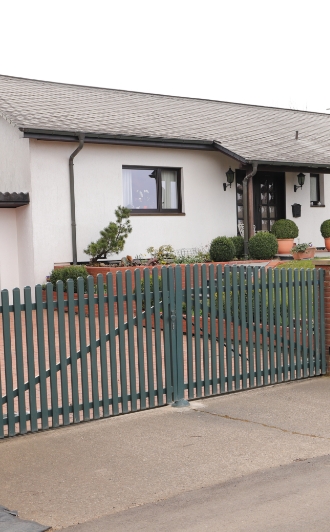
The work in this district splits fairly cleanly. One kind is a lifestyle-block or house entrance where visibility and the look of the thing matter most. The other is a working entrance sized for tankers, trucks or machinery, where width and duty cycle decide everything. Tell us which one you have and the first visit gets a lot more useful.
Phone us on 027 424 0600 or email info@groupone.co.nz, 7am to 3pm Monday to Friday. Group One New Zealand, Unit 1, 37 Foremans Road, Islington, Christchurch 8042. NZBN 9429053752833.
Call 027 424 0600 to Request a Free Quote
Comprehensive Line Marking & Safety Services
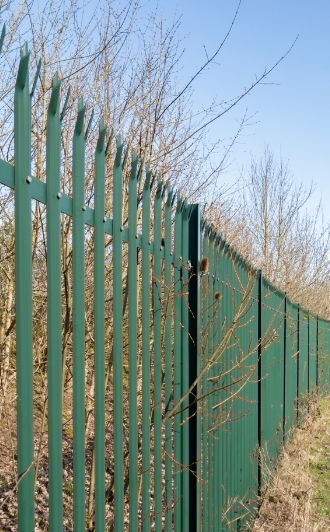
Safety and Palisade Fencing
Safety and palisade fencing is the steel perimeter that goes...
More Details
Areas We Serve
- Security Gates Amberley
- Security Gates Ashburton
- Security Gates Christchurch
- Security Gates Darfield
- Security Gates Kaiapoi
- Security Gates Methven
- Security Gates Rangiora
- Security Gates Rolleston
- Security Gates Timaru
Other Services Available in Darfield
- Automatic Gates Darfield
- Bollards Darfield
- Commercial Gates Darfield
- Convex Safety Mirrors Darfield
- Custom Gates Darfield
- Driveway Gates Darfield
- Gate Access Systems Darfield
- Industrial Gates Darfield
- Line Marking Darfield
- Safety and Palisade Fencing Darfield
- Speed Humps Darfield
- Wheel Stops Darfield
Questions from Darfield properties
What do security gates cost in Darfield?
Quoted per site. Opening width, height, frame and infill spec, hardware, ground conditions and finish all move the figure, and a rural entrance usually needs more post and footing work than a town one.
Can we have a solid timber gate on the road boundary?
Talk to the Council first, because the district plan rules cover visibility as well as height. Solid infill low with an open profile above is the design that usually satisfies both the rule and the driver pulling out.
Is metal or wood the better choice out here?
Metal for the frame. Timber does well as infill, and on a wide leaf a metal frame is what keeps it from dropping out of square after a few nor’west seasons.
How wide should the opening be?
Take the longest vehicle that will ever use it, then add the room a driver needs to line up off the road. That is usually wider than the existing gap.
Get Started with Professional Line Marking Solutions

Get a Free Consultation
Speak with our experts to discuss your line marking requirements and get a tailored solution.
Schedule Now
Need Help Choosing?
Our team provides advice on the right line marking services and materials for your site.
Find Your Solution
Talk to an Expert
Have questions or want a quote? Connect with our experienced team today.
Contact Us