 Available 24 Hours a Day, 7 Days A Week
  027 424 0600

Security Gates Kaiapoi

Available 24 Hours a Day, 7 Days A Week

100% Client Satisfaction

Full Range of Premier Services

High-Quality Products
Get A Free Quote

A light-industrial unit of 70 to 400 square metres has no perimeter to defend. It has one roller-door frontage, or one shared yard, and that single opening is what most security gates in Kaiapoi are asked to close. Group One New Zealand designs, manufactures and installs them, with crews travelling up from Islington in Christchurch, and Sydney Chappell started the New Zealand company in 2026. Phone us on 027 424 0600, 7am to 3pm Monday to Friday, and we will come and look at the opening before anything is quoted.
A physical gate at a physical entrance
The subject here is a fabricated leaf hung at a property entrance: a yard, a driveway, a service lane, a unit frontage. Steel, aluminium or timber, hung on posts set into the ground, swinging or sliding. It is not a retail security door or a shopfront shutter, which is a separate trade. It is not the release gate that software teams run in a build pipeline, which shares the words and nothing else. Everything described here is made in New Zealand and installed on a Canterbury site by the crew that built it.
Call 027 424 0600 to Request a Free Quote
Industries We Serve
We proudly serve clients across a range of sectors, including:

Hospitals

Aviation Surfaces

Schools

Sporting Surfaces

Factory Safety Lines

Body Corporate

Gating a small commercial site
A tight site changes which gate form works. There is often no arc for a swing leaf, because the vehicle standing area starts at the gate line. There is frequently no run-back either, because the neighbouring tenancy starts where your boundary stops.
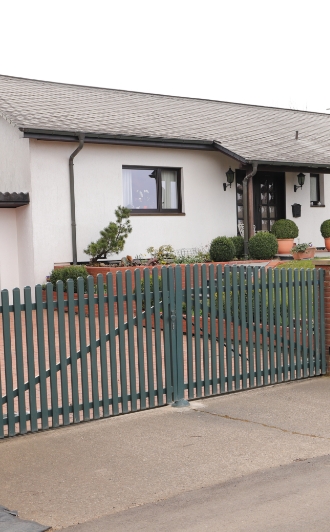
That pushes a lot of these openings toward a bi-fold, which folds into itself, or a cantilever slider where the boundary does give you a few metres to park the leaf against and the yard surface will not keep a ground track clean. Swing gates still suit a driveway on a residential section, and a slider on a track is fine where the run-back and the surface both cooperate. On a shared yard, the other question is who else uses it: a separate pedestrian gate means staff and couriers are not walking through the vehicle opening, and it keeps the main leaf from being cycled all day.
The road boundary is the rule that bites
Waimakariri District Council only becomes involved in fencing where a building or resource consent is required, or where the structure adjoins Council land. That sounds permissive until you look at where a commercial gate actually sits.
The Council advises that a resource consent is likely for any fence on the road boundary or on an internal boundary. A street-front gate on a unit frontage is on the road boundary, and a gate closing a shared yard between two tenancies is on an internal one. Nationally, a building consent is not required for fences or hoardings up to 2.5 metres, and district plans made under the Resource Management Act commonly require a resource consent above about 2 metres. Where the gate lands on a shared boundary, the Fencing Act 1978 sets the process with your neighbour. Check what applies at your address with Waimakariri District Council before the job is priced.

The 100 mm rule, and clearance generally
Waimakariri publishes one rule written specifically about gates rather than fences: for a pool barrier, it must not be possible to raise the gate so that the ground clearance is more than 100 mm. Pool and spa barrier gates sit outside the general fencing exemption and carry their own requirements, so that one is not optional.
The logic behind it is worth borrowing for every other gate on a site. A generous gap under a leaf is the easiest thing to design out and the hardest to fix afterwards, because closing it later means either a new leaf or re-levelling the ground. We set clearance at the design stage against the finished surface, not the surface as it looks the day we measure.
Footings, drainage and what sits under the track
Kaiapoi sits behind the Waimakariri and Kaiapoi River stopbanks, and district climate projections point to less annual rainfall overall but more frequent and severe storms. For a gate, that means the water that does arrive comes fast.
Two details follow. Post footings are set for the ground actually present at the hole rather than to a standard depth, and where a ground track is used, the fall and the drainage along it matter as much as the track itself. A track that ponds silts up, and a silted track is a gate that stops closing cleanly. On sites where that is likely, a cantilever slider removes the problem by carrying the leaf clear of the ground entirely.
Need Professional Line Marking or Safety Products?
Contact Group One today – reliable, accredited, and available 24/7.

Client Testimonials


5.0 Stars / 21 + reviews
The team from Group One were exceptional.
They arrived on time, did a fantastic job and made our childcare centre carpark look like new . Thankyou
Prompt and efficient service.
Very professional and experienced. Syd always answers his phone otherwise calls you back. Highly recommended.
Highly recommended.
Competitive price, quality work and even helped me put up the customer parking signs. Went above and beyond. Thanks very much, Syd and Blake.
Great job and no complaints!
Wonderful to work with and helping us get our line marking completed. Would definitely use again and refer to others.
Highly Recommend Group 1 Linemarking!
We recently hired Group 1 Linemarking for a few of our residential strata projects, and the results exceeded our expectations. The team was punctual, professional, and clearly experienced. The line marking was crisp, precise, and done exactly to spec. Communication throughout the process was smooth, and they were flexible with scheduling, which made things a lot easier on our end. If you need reliable, high-quality line marking services, I wouldn’t hesitate to recommend Group 1. Great job!
Working with Syd and his team is always a pleasure
The quality of work is always to a high standard. The Group One team is always professional, they apply a high standard for safety ensuring their SWMS is tailored for the job and their equipment is serviced and well maintained. I highly recommend Group One and if you use them you won’t be disappointed.
How the leaf is put together
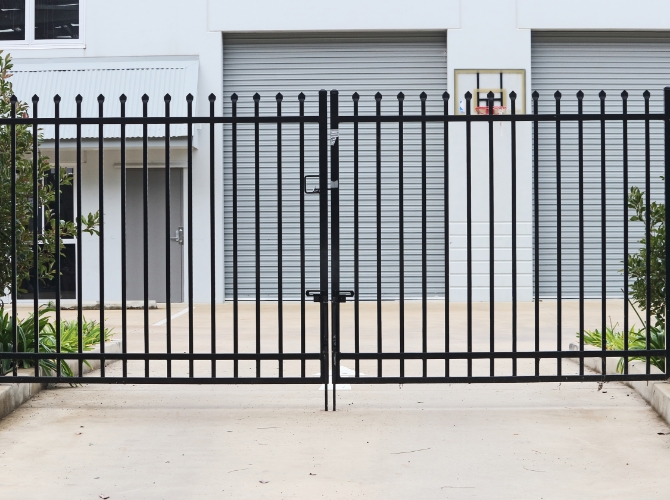
Frame section is sized to the leaf, so a wide vehicle gate carries much heavier box section than a personnel gate. Infill is welded or mechanically fixed into the frame rather than screwed to its face. Hinges carry anti-lift detail so the leaf cannot be raised off its pins, and exposed fixings are tamper-resistant.
Drop bolts land in ground sockets on double swing gates, and locking points are placed to suit the leaf height rather than sitting at handle level by default. Posts are sized and footed for the leaf weight and the ground. Steel is hot-dip galvanised before it is powder coated, so the protection sits under the colour. Where an anti-climb head is wanted, that means extended vertical bar, a raked top or a rolled edge. Infill choice is the other half of it: solid sheet and close-boarded timber give privacy and catch the north-west wind, while vertical bar, palisade and welded mesh let it through and stay difficult to climb.
Steel, timber, aluminium and stainless steel
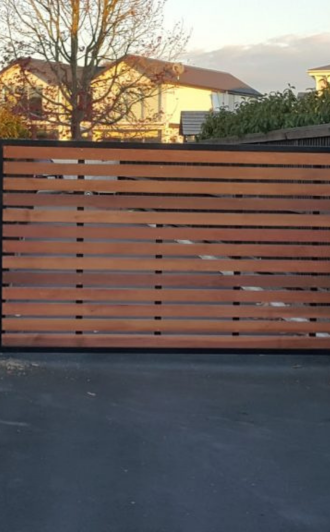
Our range of materials covers wood, steel, aluminium and stainless steel. Steel gives the stiffest frame and suits wide commercial openings and anything that will take knocks. Aluminium is lighter, so the hinges, posts and footings all work less, and it does not rust. Stainless goes into fixings and exposed fittings. Timber reads well on a residential frontage or a retail entrance and moves with the seasons, which is why it lasts longest as infill on a metal frame rather than as the structure.
Call 027 424 0600 to Request a Free Quote





What we price off at a small tenancy
No figures go on this page, because the entrance sets them. On a unit of 70 to 400 square metres the input that moves a quote furthest is often not width at all. It is the gate form the site leaves you with. A bi-fold or a cantilever is a different build from a plain swing pair, and a tight tenancy tends to rule out the simplest option before anything else gets discussed.
After that we are pricing footings and whatever sits under a track, which behind the stopbanks means the ground at the hole and the drainage around it; the clear opening width and the leaf height; frame section and infill; the locking points and the ground clearance they are set against; and the finish. Where the yard is shared, the pedestrian gate is drawn and priced with the vehicle leaf rather than bolted on afterwards.
Design, manufacture and installation follow once the drawing is agreed. Every gate is made in New Zealand and installed by our own crew, and the work carries a warranty and after-sales service.
Group One New Zealand, and the size of the outfit
We are a handful of people, which is the plain reason a 70-square-metre light-industrial unit gets the same attention as a big yard: whoever draws the gate builds it and hangs it. In practice that is one visit covering the frontage, the ground under a track and the drainage around the posts, not three appointments and a chain of subcontractors passing notes between them. Kaiapoi work is reached from Christchurch, out of the Islington base and over the Waimakariri. That is close enough for measuring up and installing to be two short trips instead of an expedition, which is how a modest frontage stays worth doing properly. Sydney Chappell started the company in 2026. Where you see a longer run of years attached to the group, it belongs to the parent operation in Australia: “Although Group 1 Line Marking has just started here in New Zealand, as a group we have been operating in Australia for almost 25 years.” There is more on the page.
Call 027 424 0600 to Request a Free Quote

If you are leasing the unit, start with the landlord
A gate is a fixed structure on someone’s title, so on a leased tenancy the landlord’s agreement comes before the design, not after it. Get that conversation started and we can work to whatever it allows.
Phone us on 027 424 0600 or email info@groupone.co.nz, 7am to 3pm Monday to Friday. Group One New Zealand, Unit 1, 37 Foremans Road, Islington, Christchurch 8042. NZBN 9429053752833.
Call 027 424 0600 to Request a Free Quote
Comprehensive Line Marking & Safety Services
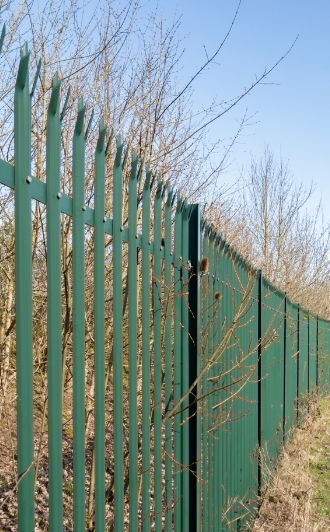
Safety and Palisade Fencing
Safety and palisade fencing is the steel perimeter that goes...
More Details
Areas We Serve
- Security Gates Amberley
- Security Gates Ashburton
- Security Gates Christchurch
- Security Gates Darfield
- Security Gates Kaiapoi
- Security Gates Methven
- Security Gates Rangiora
- Security Gates Rolleston
- Security Gates Timaru
Other Services Available in Kaiapoi
Questions from Kaiapoi sites
What do security gates cost in Kaiapoi?
Quoted per site. Opening width, height, frame and infill spec, hardware, ground conditions and finish all move the figure, and a tight commercial opening often needs a different gate form rather than a bigger one.
Is a steel gate the right choice for a unit frontage?
Usually. Steel takes the width and the knocks, and once it is galvanised and powder coated the finish holds up against constant vehicle traffic.
Can you do a timber gate that suits a house in Kaiapoi?
Yes, with timber infill on a metal frame. It gives the timber look and keeps the leaf square, which a full timber gate on a wide opening will not do indefinitely.
Do we need consent for a gate across our yard entrance?
Possibly, because internal and road boundaries are where a resource consent is likely in this district. Ask the Council with your address in front of you before the design is settled.
Get Started with Professional Line Marking Solutions

Get a Free Consultation
Speak with our experts to discuss your line marking requirements and get a tailored solution.
Schedule Now
Need Help Choosing?
Our team provides advice on the right line marking services and materials for your site.
Find Your Solution
Talk to an Expert
Have questions or want a quote? Connect with our experienced team today.
Contact Us