 Available 24 Hours a Day, 7 Days A Week
  027 424 0600
Safety and Palisade Fencing

Available 24 Hours a Day, 7 Days A Week

100% Client Satisfaction

Full Range of Premier Services

High-Quality Products
Request a Free Quote
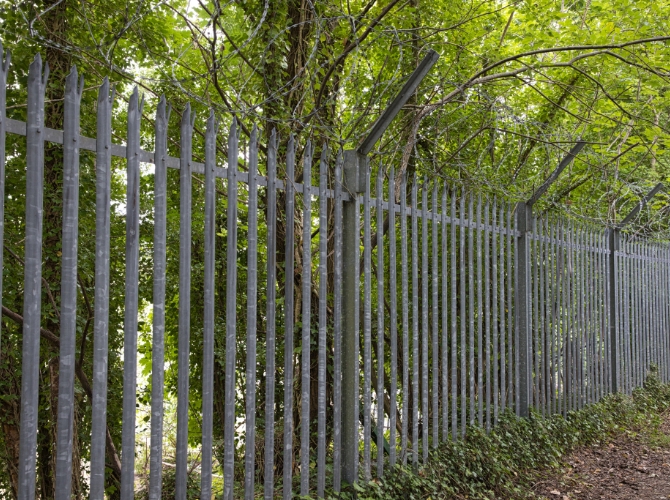
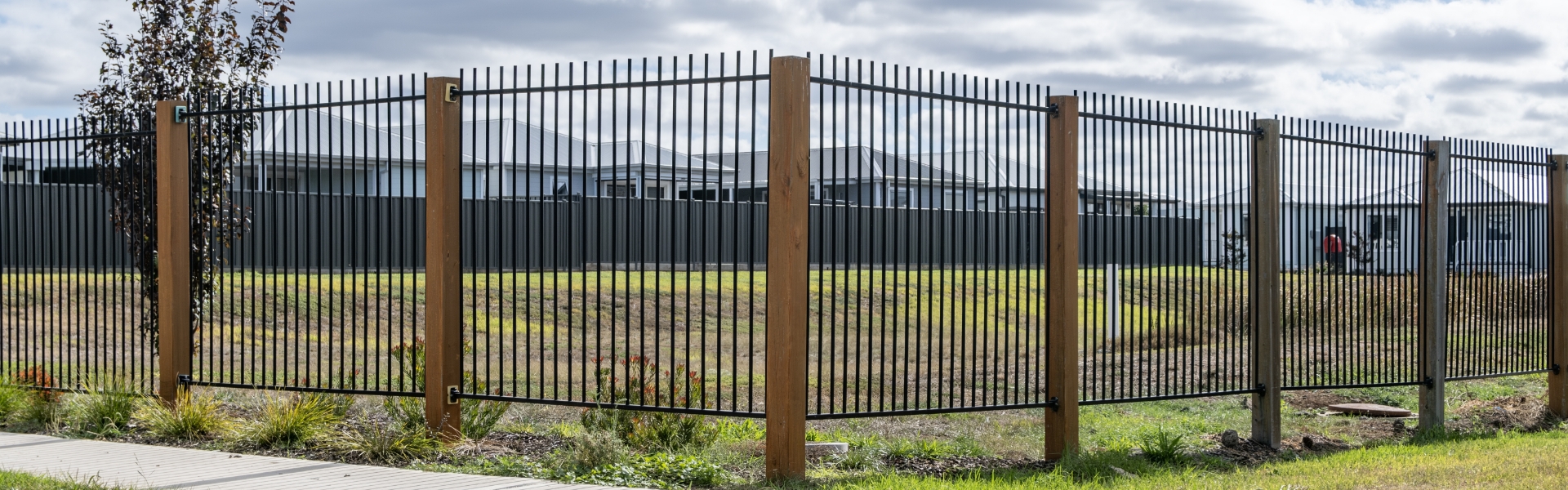
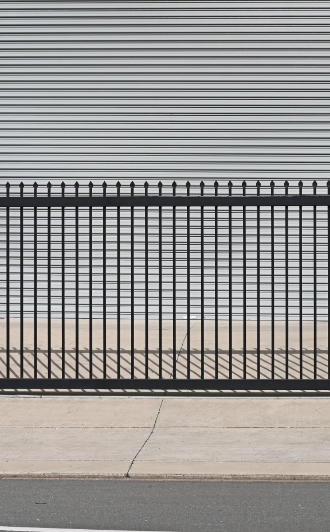
Safety and palisade fencing is the steel perimeter that goes around ground the public is not meant to walk onto. Palisade is the fence made of vertical steel pales bolted to horizontal rails, usually seen around substations, water and wastewater plants, transport corridors, contractor yards, waste and recycling sites, distribution centres and school and factory boundaries. Safety fencing is the wider category it belongs to: any barrier whose job is keeping people away from machinery, drops, traffic or stored plant rather than simply marking a line. The buyers are asset owners, facilities managers, utilities and developers, and the decision they are usually making is not whether to fence, but which fence to specify.
Palisade or mesh
Most New Zealand perimeter jobs come down to a choice between these two, and each is better at something.
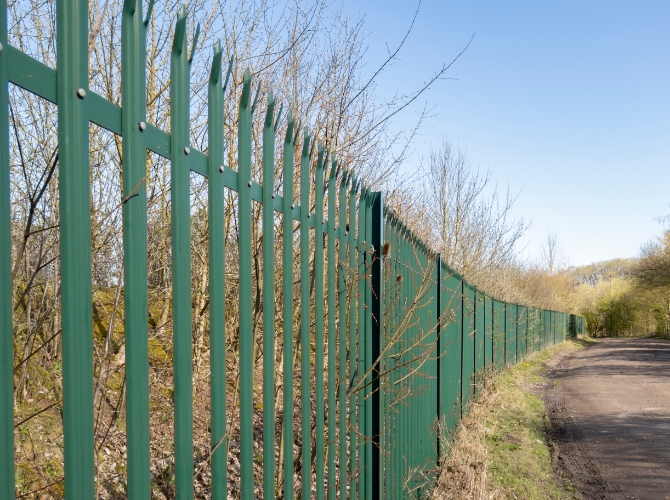
Steel palisade is bolted rather than woven, so individual pales carry load independently and a damaged section can be replaced pale by pale. The vertical form makes it awkward to scale, and it gives no visual privacy at all, which is often exactly what a site wants: nobody can shelter behind it and anyone inside can be seen from outside. It is the standard choice around utility and infrastructure assets, and it is commonly run at around 2.4 metres.
Welded anti-climb mesh has small apertures and a flat face. It gives a cleaner appearance, holds up better where a fence sits along a public frontage, and does not present pointed tops. It suits schools, commercial frontages, sports facilities and any boundary where the fence has to look civil rather than industrial.
Choose palisade where the site is genuinely industrial, the perimeter is long, damage is a fact of life and replacement parts matter. Choose mesh where appearance, public frontage or the presence of children shifts the balance. Where a site has both conditions, the answer is often both: palisade down the yard boundaries, mesh across the street face.
Two other products sit in the same family. Chainlink is the low-cost option for enclosing an area rather than protecting it. Safety barriers and guardrail are what you use inside a site, protecting racking, plant, pedestrian routes and building corners from vehicles, and they answer a different question altogether.
Call 027 424 0600 to Request a Free Quote
How Group One New Zealand builds a perimeter
Fencing at Group One New Zealand is a fabrication job, not a distribution one. Sydney Chappell founded the company in 2026, and the steel is cut, welded and finished at Unit 1, 37 Foremans Road, Islington, Christchurch 8042 before it goes anywhere near your boundary. Our range of materials covers wood, steel, aluminium and stainless steel, and the gates in a fenced perimeter come from the same workshop, which is why the gate ends up matching the fence rather than approximating it. Everyone in our team has a vast amount of industry experience behind them to apply to each project undertaken, we are a small team, so you know you’ll get the very best, and we guarantee all the work we do.
Sites we reach run from Amberley in the north to Timaru in the south, and west towards the Canterbury foothills. If your property or commercial site is irregular, tricky, lacking in space or hard to reach, that is a normal starting point rather than an obstacle. Phone us on 027 424 0600 or email info@groupone.co.nz, 7am to 3pm Monday to Friday, and we will arrange a look at the boundary.
The pointed tops, stated plainly
Palisade tops are pointed, and that is not decorative. The whole deterrent effect of the fence depends on the top being unpleasant to grab. The trade-off is real: a pointed top can injure someone attempting to climb it, so warning signage is often appropriate on a boundary the public can reach, and pointed profiles are the wrong specification where children are likely to be against the fence.
There is a practical version of the same point. Below the deterrent height, the fence should present no sharp edges or protruding fixings that anyone can catch themselves on in normal use. That is a detailing decision made at design stage, and it is one of the reasons a fence like this benefits from being drawn before it is ordered.
Call 027 424 0600 to Request a Free Quote
Industries We Serve
We proudly serve clients across a range of sectors, including:

Hospitals

Aviation Surfaces

Schools

Sporting Surfaces

Factory Safety Lines

Body Corporate
What actually gets specified
Beyond the palisade-or-mesh call, these are the decisions that change the fence you end up with:
- Height, set by what the fence has to deter and by any district plan limits on your boundary
- Pale profile, whether flat, D-section or W-section, and how it is topped
- Rail count, since a taller fence needs more horizontal rails to stay rigid
- Fixings, from standard bolts through to security fasteners that cannot be undone with ordinary tools
- Coating, hot-dip galvanising as the base, with powder coat over it where appearance or coastal exposure asks for more
- Footings, which follow the ground rather than the fence: soft or reclaimed ground, rock, and existing concrete each need a different answer
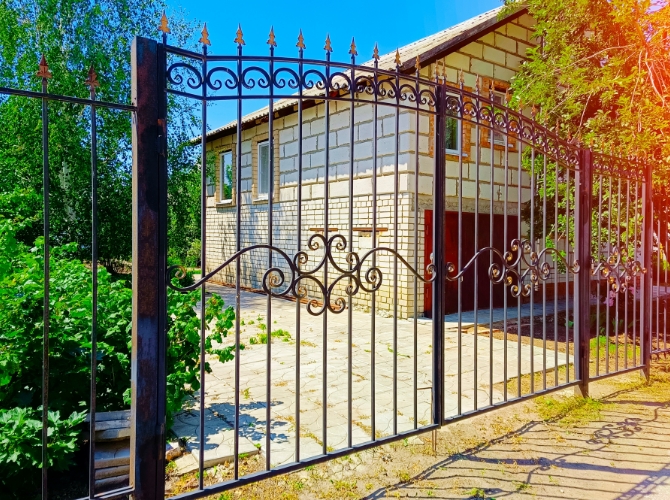
- Gates and access, including swing or sliding vehicle gates, pedestrian gates and any access control fitted to them
Design, manufacture and installation
Design starts at your boundary. We’ll come out and take a look at the site and discuss ideas with you about the best solution for your situation, walking the line, noting the levels and the ground conditions, checking where gates and vehicle access have to fall, and confirming where the boundary actually is.
Manufacture is the workshop stage: pales, rails, posts, gates and hardware built and finished to that line and those levels, so what arrives on site fits the site.
Installation is set-out, footings, posts, panels and gates, working in a sequence that keeps the site secure while the work runs. On a boundary with a fall, the fence is either stepped or raked, and which one you get is a decision worth making at design stage rather than watching it happen.
Call 027 424 0600 to Request a Free Quote
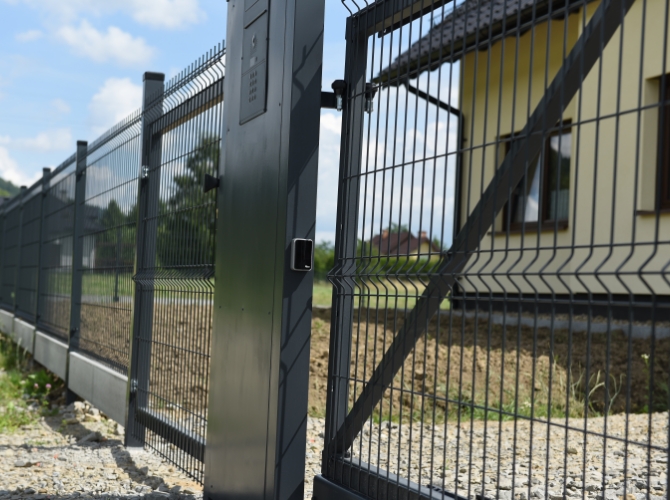
What a fencing quote is built from
Pricing is on quote. The number follows the length of the boundary, the height and profile specified, the coating, the number and type of gates, the ground the posts are going into, whether an old fence has to come out first, and how easily the crew and the materials can get to the line.
Other site safety work nearby
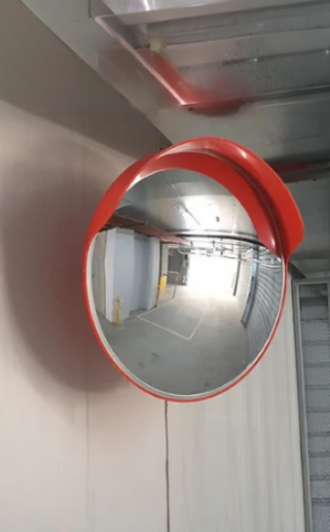
A perimeter is rarely the only safety item on a site. Convex safety mirrors, town by town:
- Convex Safety Mirrors Amberley
- Convex Safety Mirrors Ashburton
- Convex Safety Mirrors Christchurc
- Convex Safety Mirrors Darfield
- Convex Safety Mirrors Kaiapoi
- Convex Safety Mirrors Methven
- Convex Safety Mirrors Rangiora
- Convex Safety Mirrors Rolleston
Get the boundary walked
Worth knowing before you plan around a contribution: cost sharing between neighbours only ever extends to an adequate fence for those two properties. A security-grade steel perimeter is well beyond that standard, so on a shared boundary the difference between an ordinary fence and the fence your site actually needs sits with you, and that is a conversation to have before the notice goes out rather than after. Everywhere else on the line, the specification is simply yours to make.
Phone us on 027 424 0600 or email info@groupone.co.nz, 7am to 3pm Monday to Friday. Group One New Zealand, Unit 1, 37 Foremans Road, Islington, Christchurch 8042. NZBN 9429053752833.
Call 027 424 0600 to Request a Free Quote
Need Professional Line Marking or Safety Products?
Contact Group One today – reliable, accredited, and available 24/7.

Client Testimonials


5.0 Stars / 21 + reviews
The team from Group One were exceptional.
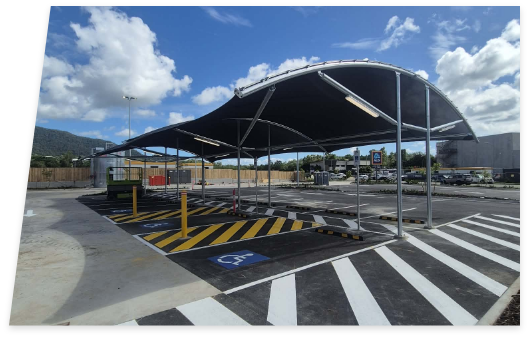
They arrived on time, did a fantastic job and made our childcare centre carpark look like new . Thankyou
Prompt and efficient service.
Very professional and experienced. Syd always answers his phone otherwise calls you back. Highly recommended.
Highly recommended.
Competitive price, quality work and even helped me put up the customer parking signs. Went above and beyond. Thanks very much, Syd and Blake.
Great job and no complaints!
Wonderful to work with and helping us get our line marking completed. Would definitely use again and refer to others.
Highly Recommend Group 1 Linemarking!
We recently hired Group 1 Linemarking for a few of our residential strata projects, and the results exceeded our expectations. The team was punctual, professional, and clearly experienced. The line marking was crisp, precise, and done exactly to spec. Communication throughout the process was smooth, and they were flexible with scheduling, which made things a lot easier on our end. If you need reliable, high-quality line marking services, I wouldn’t hesitate to recommend Group 1. Great job!
Working with Syd and his team is always a pleasure
The quality of work is always to a high standard. The Group One team is always professional, they apply a high standard for safety ensuring their SWMS is tailored for the job and their equipment is serviced and well maintained. I highly recommend Group One and if you use them you won't be disappointed.
Questions people ask
How secure is palisade fencing?
Secure enough that it is the default around substations, water treatment plants and depots. It is a physical barrier that resists climbing and forced entry, it is hard to see through in any useful way, and it is easily inspected. No fence is absolute on its own, which is why the fence, the gates, the lighting and the access control are specified together.
What are the pros and cons of palisade fencing?
For it: strength, individually replaceable pales, long service life once galvanised, low maintenance, and a clear boundary that separates people from plant and traffic. Against it: it is an industrial look on a residential or retail frontage, the pointed tops carry the injury risk described above, and it offers no privacy or wind shelter.
What are the safety hazards associated with fencing?
Mostly the ones that appear over time. Loose pales, corrosion, damaged posts and missing bolts all reduce both safety and security, so a perimeter fence wants a walk-around inspection on a regular cycle. Gates carry their own risks and need locking hardware that cannot close on somebody by accident. During construction, an open boundary and post holes are the hazards to manage.
Does my neighbour have to pay for half the fence in NZ?
Between two private properties, the Fencing Act 1978 has neighbours share the cost of an adequate fence for the properties concerned, and there is a written Fencing Notice process before the work starts. That obligation is a shared boundary matter, and a fence facing a road, a reserve or your own internal yard is not one.
Comprehensive Line Marking & Safety Services
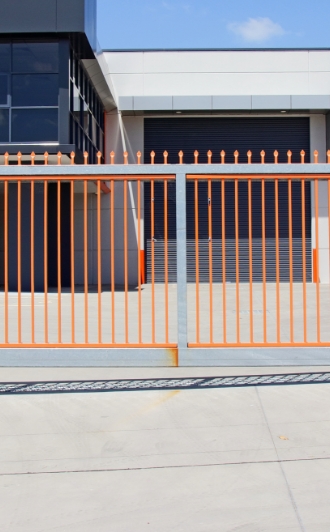
Sliding and Electric Gates
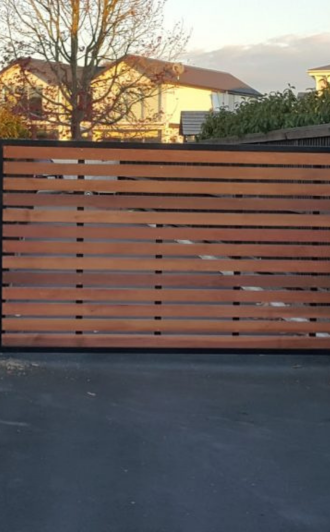
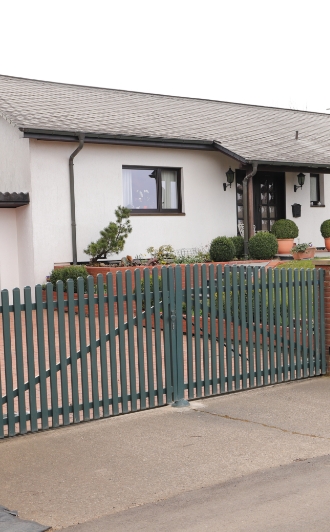
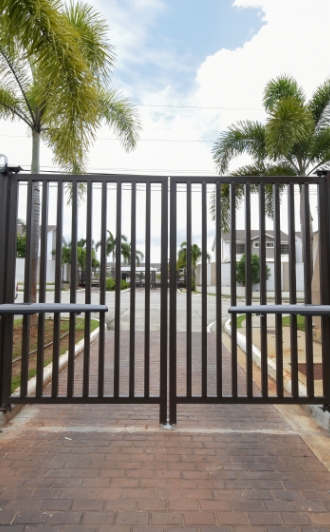
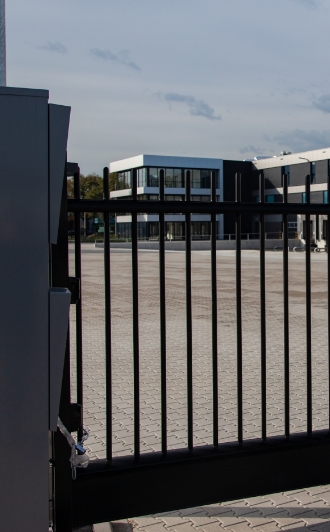
Group One provides professional sliding and electric gate solutions...
More Details
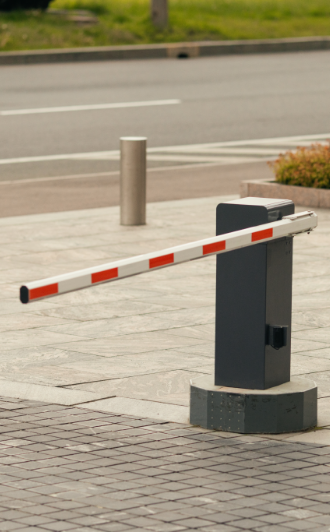
Barrier Arms & Boom Gates
Control vehicle access with reliable barrier arm and boom gate...
More Details
Get Started with Professional Line Marking Solutions

Get a Free Consultation
Speak with our experts to discuss your line marking requirements and get a tailored solution.
Schedule Now
Need Help Choosing?
Our team provides advice on the right line marking services and materials for your site.
Find Your Solution
Talk to an Expert
Have questions or want a quote? Connect with our experienced team today.
Contact Us