 Available 24 Hours a Day, 7 Days A Week
  027 424 0600

Security Gates Christchurch

Available 24 Hours a Day, 7 Days A Week

100% Client Satisfaction

Full Range of Premier Services

High-Quality Products
Get A Free Quote

Hang a well-made leaf on an undersized post and the whole thing sags inside a year. Group One New Zealand fabricates security gates for Christchurch entrances: frame section, infill, hinges, locking points, posts and footings, each specified for the opening it is going into. Sydney Chappell founded the New Zealand company in 2026, and crews travel out from Unit 1, 37 Foremans Road in Islington. Posts do most of the quiet work. Phone us on 027 424 0600, 7am to 3pm Monday to Friday, and we will look at the entrance before putting anything in writing.
What a security gate is, and what it is not
A security gate here means a fabricated leaf hung at a property entrance: a driveway, a yard, a compound, a side path. It is built from steel, aluminium or timber, hung on posts set into the ground, and it either swings or slides. It is not a shopfront security door or a roller shutter, which belong to a different trade, and it is not the release gate software teams run in a build pipeline, which shares the words and nothing else. Everything here is made in New Zealand and installed on a Canterbury site by the crew that built it.
Call 027 424 0600 to Request a Free Quote
Industries We Serve
We proudly serve clients across a range of sectors, including:

Hospitals

Aviation Surfaces

Schools

Sporting Surfaces

Factory Safety Lines

Body Corporate

Swing, slider, cantilever or bi-fold
The form follows the opening:
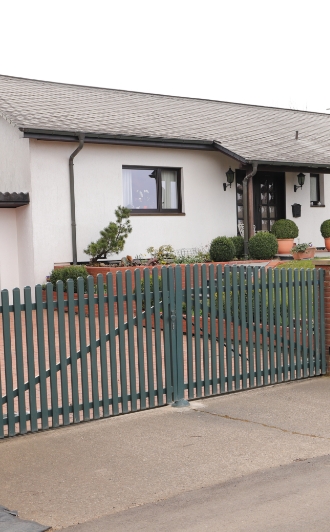
- Swing gates, single or double leaf: simplest hardware, but they need clear arc room and reasonably level ground through the whole swing.
- Sliding gates on a ground track: no arc, but they need run-back space alongside the opening for the leaf to park in.
- Cantilever sliders: counterbalanced off the run-back, with no ground track to fill with grit, silt or ice. The answer where the ground is uneven.
- Bi-fold gates, where there is neither arc room nor run-back and the leaf has to fold into itself.
- A pedestrian or personnel gate beside the vehicle leaf, so people are not walking through the same opening a car uses.
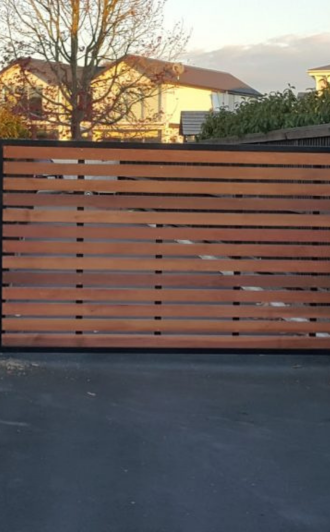
Infill is the second decision. Solid sheet or close-boarded timber gives privacy and takes the full weight of the wind. Vertical bar and palisade profiles give a leaf that is difficult to climb without that sail area. Welded mesh sits between the two, and slatted aluminium lets you tune how much you can see through.
What makes a leaf hard to get through
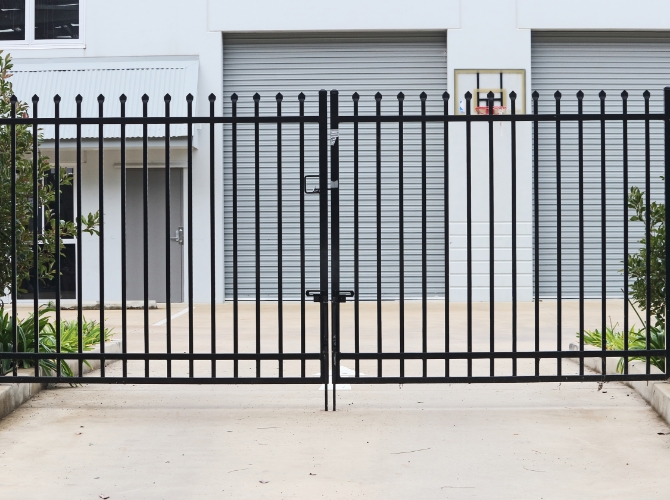
Frame section is sized to the leaf, so a four metre vehicle leaf carries much heavier box section than a pedestrian gate. Infill is welded or mechanically fixed into the frame rather than screwed onto the face of it. Hinges carry anti-lift detail so the leaf cannot be raised off its pins, exposed fixings are tamper-resistant, and where an anti-climb finish is wanted the top of the leaf is treated: extended vertical bars, a raked head, or a rolled top.
Then the closing detail. Drop bolts into a ground socket hold the leading edge of a double swing gate, and locking points suit the leaf height rather than sitting at handle level out of habit. Ground clearance under the leaf is kept tight, which matters as much for a pool or spa barrier gate as for a yard. Posts are sized and footed for the leaf weight and the ground, and steel is hot-dip galvanised before it is powder coated, so the protection sits under the colour.
Timber, steel, aluminium and stainless steel
Our range of materials covers wood, steel, aluminium and stainless steel. Steel gives the stiffest frame and suits wide vehicle leaves and industrial openings, provided it is galvanised and coated properly. Aluminium is lighter, which takes load off the hinges, posts and footings, so it often wins on long leaves and on sliders. It does not rust. Stainless turns up in hardware and exposed fittings. Timber moves with the seasons, so it usually works best as infill on a steel or aluminium frame rather than as the structure.
Nor’westers, frost and the fall across the opening
The nor’wester arrives warm, dry and gusty and can push the city above 30°C, and every gust that hits a solid panel goes through the hinges into the post and its footing. That is the most common reason a city entrance ends up with a ventilated or vertical-bar profile instead of the solid one the owner first pictured. Winter runs the other way: around 37 screen frosts and 90 ground frosts a year, chiefly between April and October, working on shallow footings and ground tracks alike.
Fall across the opening decides the rest. A swing leaf has to clear rising ground through its entire arc, so a driveway that climbs away from the street often ends up on a slider or a cantilever.
Need Professional Line Marking or Safety Products?
Contact Group One today – reliable, accredited, and available 24/7.

Client Testimonials


5.0 Stars / 21 + reviews
The team from Group One were exceptional.
They arrived on time, did a fantastic job and made our childcare centre carpark look like new . Thankyou
Prompt and efficient service.
Very professional and experienced. Syd always answers his phone otherwise calls you back. Highly recommended.
Highly recommended.
Competitive price, quality work and even helped me put up the customer parking signs. Went above and beyond. Thanks very much, Syd and Blake.
Great job and no complaints!
Wonderful to work with and helping us get our line marking completed. Would definitely use again and refer to others.
Highly Recommend Group 1 Linemarking!
We recently hired Group 1 Linemarking for a few of our residential strata projects, and the results exceeded our expectations. The team was punctual, professional, and clearly experienced. The line marking was crisp, precise, and done exactly to spec. Communication throughout the process was smooth, and they were flexible with scheduling, which made things a lot easier on our end. If you need reliable, high-quality line marking services, I wouldn’t hesitate to recommend Group 1. Great job!
Working with Syd and his team is always a pleasure
The quality of work is always to a high standard. The Group One team is always professional, they apply a high standard for safety ensuring their SWMS is tailored for the job and their equipment is serviced and well maintained. I highly recommend Group One and if you use them you won’t be disappointed.

Height, transparency and Christchurch City Council
Christchurch City Council requires a building consent for a fence or hoarding over 2.5 metres, measured vertically from the top of the structure to the supporting ground directly below. That is only half the question. In the Character Area Overlay, the Residential New Neighbourhood Zone and the medium and high density residential zones, lower and/or visually transparent designs are required unless resource consent is obtained. The tall solid leaf a security-minded owner assumes is often the design the district plan will not accept, and the workable answer is a vertical-bar profile that is hard to climb without being a solid wall.
Three more rules bite at a gate. Anything near a stream, river or open drainage channel must sit at least 3 metres from the bank, or one third of the District Plan waterway setback, whichever is larger, or a resource consent is needed. A safety barrier is required wherever the fall is 1 metre or more. Pool and spa barrier gates sit outside the general exemption altogether. Where the gate sits on a boundary shared with a neighbour, the Fencing Act 1978 covers how the two of you deal with it. Confirm the current position with Christchurch City Council before the job is priced or started.
Putting a harder gate on an entrance you already have
Plenty of city work is replacement rather than first fit: a timber leaf that has dropped, a compound gate repaired more than once, a frontage where the fence is sound and the gate is the part letting it down. The first question is whether the existing posts and footings will carry the new leaf, because on a retrofit the posts are usually the limit rather than the gate.
Call 027 424 0600 to Request a Free Quote





Where the cost actually sits
Pricing is on quote, and in this city the district plan often settles the largest input before we get to it. A zone that requires a lower or visually transparent design pushes the leaf toward a vertical-bar or palisade profile, and that one decision runs through the frame section, the infill, the leaf weight and the hardware carrying it.
On a replacement, the second heavy input is what is already there. Where the existing posts and footings will not carry a stiffer, heavier leaf, the posts are the job and the gate is the easy part, and the quote should say that in plain words instead of burying it in a line item.
The rest is the ordinary list: clear opening width, gate height, gate form and whether the entrance has arc room or run-back for it, locking points and drop bolts, ground conditions and the fall across the opening, and the finish. With as many operators as this city carries, the only useful thing to set against a number given over the phone is a written quote that shows which of those inputs is driving it.
Design, manufacture and installation then run in sequence, all of it New Zealand made, with the workmanship and the after-sales service guaranteed.
Group One New Zealand, a fabricator first
More than forty gate, automation and security operators surface in Christchurch listings, so the honest way to place ourselves is by what we make, not by how long our list of services runs. We fabricate: frame section, infill profile, anti-lift hinge detail, post size and footing depth, then the hanging and the setting of every locking point. Drawing through to installation stays with one crew working out of Islington on the western edge of the city, which on a job in this city means nobody is travelling far to look at it. The company itself dates from 2026, when Sydney Chappell founded it, and there are few of us. The quarter century attached to the name is Australian, and the wording is the company’s own: “Although Group 1 Line Marking has just started here in New Zealand, as a group we have been operating in Australia for almost 25 years.” Full credentials and the rest of the range are on the page.
Call 027 424 0600 to Request a Free Quote

Get the zone question answered first
Settle the district plan question before a drawing is done, because a zone rule can rewrite the design after the steel is cut. Send us the address and we will look at the entrance with that constraint already on the table.
Phone us on 027 424 0600 or email info@groupone.co.nz, 7am to 3pm Monday to Friday. Group One New Zealand, Unit 1, 37 Foremans Road, Islington, Christchurch 8042. NZBN 9429053752833.
Call 027 424 0600 to Request a Free Quote
Comprehensive Line Marking & Safety Services
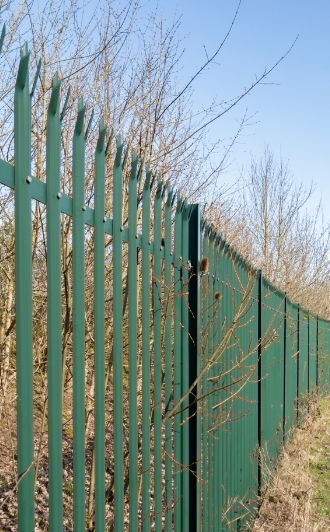
Safety and Palisade Fencing
Safety and palisade fencing is the steel perimeter that goes...
More Details
Areas We Serve
- Security Gates Amberley
- Security Gates Ashburton
- Security Gates Christchurch
- Security Gates Darfield
- Security Gates Kaiapoi
- Security Gates Methven
- Security Gates Rangiora
- Security Gates Rolleston
- Security Gates Timaru
Other Services Available in Christchurch
- Automatic Gates Christchurch
- Bollards Christchurch
- Commercial Gates Christchurch
- Convex Safety Mirrors Christchurch
- Custom Gates Christchurch
- Driveway Gates Christchurch
- Gate Access Systems Christchurch
- Industrial Gates Christchurch
- Line Marking Christchurch
- Safety and Palisade Fencing Christchurch
- Speed Humps Christchurch
- Wheel Stops Christchurch
Questions Christchurch owners ask
What do security gates cost in Christchurch?
Every gate is quoted after the site visit. Opening width, height, frame and infill spec, locking hardware, ground conditions and finish all move the number.
Is metal always the stronger choice?
Steel gives the stiffest frame, but a heavy leaf loads the hinges and posts harder. On a wide opening an aluminium frame often outlasts a steel one because the whole assembly is working less.
Sliding or swinging on a city section?
Run-back space decides it. With a clear length of boundary beside the opening, a slider avoids the arc problem entirely. Without it, a double swing or a bi-fold is the way through.
Do I need consent for a 1.8 metre gate?
Under 2.5 metres it usually sits outside the building consent requirement, but the zone rule is separate and can still apply, especially on a road boundary. Ask the council before you commission the design.
Get Started with Professional Line Marking Solutions

Get a Free Consultation
Speak with our experts to discuss your line marking requirements and get a tailored solution.
Schedule Now
Need Help Choosing?
Our team provides advice on the right line marking services and materials for your site.
Find Your Solution
Talk to an Expert
Have questions or want a quote? Connect with our experienced team today.
Contact Us