 Available 24 Hours a Day, 7 Days A Week
  027 424 0600

Speed Humps Amberley

Available 24 Hours a Day, 7 Days A Week

100% Client Satisfaction

Full Range of Premier Services

High-Quality Products
Get A Free Quote

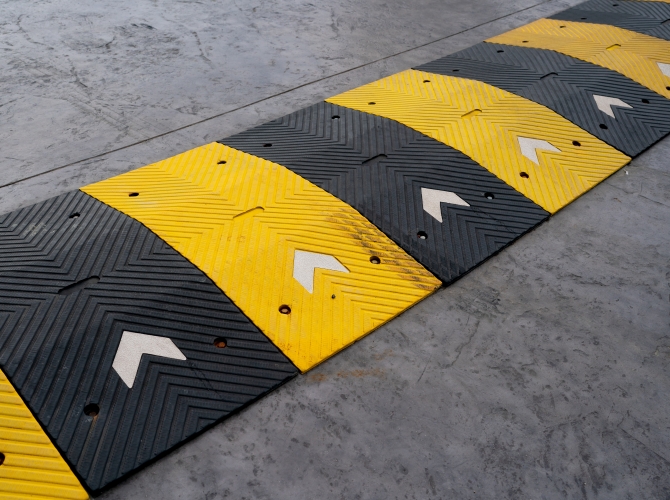
The most instructive thing about speed humps in Amberley, North Canterbury, happened a few kilometres down the road at Leithfield Beach, where recently installed humps sat too high and the district council had to book a milling machine to cut them back down, with road marking rebooked behind it. A speed hump is a raised profile across a lane, formed in the surface or fixed on top, built so that crossing at speed is uncomfortable. Get the profile wrong and you have bought yourself a second job. On a public road here the decision belongs to Hurunui District Council, or to NZ Transport Agency where the route is a state highway. On land you own, it is yours, with nothing to apply for. Group One New Zealand designs, manufactures and installs traffic calming, with crews travelling north from Foremans Road in Islington, Christchurch. Sydney Chappell founded the New Zealand company in 2026.
The Leithfield Beach lesson
The council’s own notice is the useful bit: the humps went in, they were too high, a milling machine was the earliest fix available and the markings had to be redone afterwards. Nobody was careless. It is simply that height, profile and the approach a driver gets are the whole performance of the device, and they are easier to argue about on paper than to correct in asphalt.
That is the strongest argument on this page for having calming designed and installed rather than dropped into place. A unit specified for the vehicles that actually cross it, set where the speed is, fixed properly and marked so it reads early, does not need milling in a fortnight.
Call 027 424 0600 to Request a Free Quote
Industries We Serve
We proudly serve clients across a range of sectors, including:

Hospitals

Aviation Surfaces

Schools

Sporting Surfaces

Factory Safety Lines

Body Corporate
Who decides on a public road here
Amberley is the seat of Hurunui District Council, and the council is the road controlling authority for the streets through the township. It has no published speed hump rule or dimension that we can point you at, so we will not invent one or borrow another district’s numbers. If speed on a public street here concerns you, take it to Hurunui District Council and ask what they assess and how.
State Highway 1 is NZTA’s, not the council’s. The road safety activity around the town at present is a proposed speed limit reduction on SH1 south of Amberley, from 80 km/h to 60 km/h, and no evidence of a current speed hump project inside the township itself turned up when we looked. On the highway, in other words, the tool being reached for is a limit.
Past the gate, the answer changes
Everything in the road corridor is the council’s or NZTA’s. Everything inside your boundary is yours to decide. A retirement village internal road, a farm or lifestyle block entrance, a rural-commercial forecourt, a packhouse or woolshed approach, a shop car park: the owner picks whether a hump goes in, exactly where, and what it is made of. There is no consent, no submission period and no programme to wait for. If the entrance already runs , it is worth mentioning at the site visit, because vehicles are stopping there anyway and the speed builds past the gate rather than at it. That single distinction is what most people are actually looking for when they start reading about this.

The devices, and where each belongs
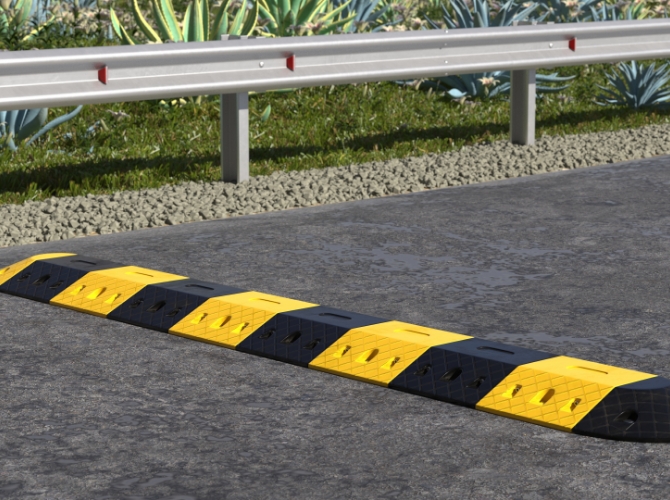
- Full-width humps: entrances and car park aisles where every vehicle should slow.
- Speed cushions: routes used by trucks, tankers and tractors, which straddle instead of climbing.
- Raised tables and raised pedestrian crossings: at the point people cross on foot, so they stay at kerb level.
- Modular rubber and bolt-down units: fixed to sound asphalt or concrete, and liftable if the placement needs changing.
- Deployable and temporary units: seasonal traffic, events and works.
- Formed asphalt or concrete profiles: permanent, shaped into the surface as it is laid.
Where the pedestrians are the reason for the hump
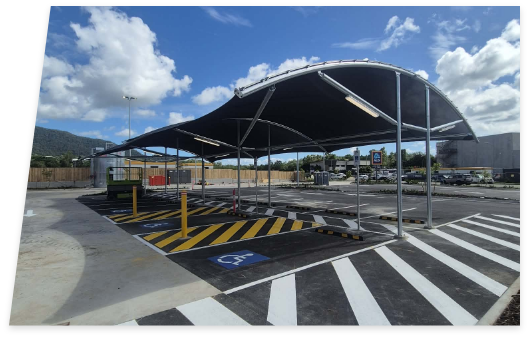
Amberley is a rural service centre of 2,520 residents with an older, settled ownership base (median age 52.7), and a 250-home retirement village is being developed on 37 acres in the centre of town. On a site like that the traffic is light and the walking is constant, which flips the usual calculation: the device is there for the person crossing to the letterboxes, not for the volume of vehicles.
Around the town, the calls come from dairy, sheep, arable and grape-growing enterprises with long entrances off a fast rural road, and from rural-commercial premises where customer parking and delivery movements share one surface.
Need Professional Line Marking or Safety Products?
Contact Group One today – reliable, accredited, and available 24/7.

Client Testimonials


5.0 Stars / 21 + reviews
The team from Group One were exceptional.
They arrived on time, did a fantastic job and made our childcare centre carpark look like new . Thankyou
Prompt and efficient service.
Very professional and experienced. Syd always answers his phone otherwise calls you back. Highly recommended.
Highly recommended.
Competitive price, quality work and even helped me put up the customer parking signs. Went above and beyond. Thanks very much, Syd and Blake.
Great job and no complaints!
Wonderful to work with and helping us get our line marking completed. Would definitely use again and refer to others.
Highly Recommend Group 1 Linemarking!
We recently hired Group 1 Linemarking for a few of our residential strata projects, and the results exceeded our expectations. The team was punctual, professional, and clearly experienced. The line marking was crisp, precise, and done exactly to spec. Communication throughout the process was smooth, and they were flexible with scheduling, which made things a lot easier on our end. If you need reliable, high-quality line marking services, I wouldn’t hesitate to recommend Group 1. Great job!
Working with Syd and his team is always a pleasure
The quality of work is always to a high standard. The Group One team is always professional, they apply a high standard for safety ensuring their SWMS is tailored for the job and their equipment is serviced and well maintained. I highly recommend Group One and if you use them you won’t be disappointed.

What the quote depends on, and how the work runs
Everything is on quote. The figure follows the device and how many, the surface it fixes into or is formed onto, access and when the area can be handed over, the traffic volumes and vehicle types crossing it, drainage, the marking and signage around it, and any reinstatement afterwards.
Design, manufacture and installation are the three stages. Design begins with a site visit and a measure-up, working out where speed builds and where people cross. Manufacture covers the unit or profile for that layout. Installation covers fixing or forming, making the surface good, and marking so a driver reads the hump before they are on it.
Group One New Zealand, north to Amberley
On a retirement-village road or a rural-commercial forecourt the pedestrians are the entire reason for the device, and that is also the side of the boundary where you can simply make the call. None of it touches the public road, which stays with Hurunui District Council. For the private side, Group One New Zealand is the outfit that would come out and do it: a small team, founded by Sydney Chappell in 2026, reaching Amberley at the northern limit of an area its crews cover out of Islington, Christchurch. The years behind the group belong to Australia, and the company spells that out: “Although Group 1 Line Marking has just started here in New Zealand, as a group we have been operating in Australia for almost 25 years.” The page lists the devices.
Call 027 424 0600 to Request a Free Quote




Better to specify it than to mill it
A hump that has to be cut back down costs twice and gets remarked twice, and the people using the site remember the first version. Tell us the surface, the vehicles that cross it and where people walk, and the profile gets chosen for that site before anything is fixed down.
Phone us on 027 424 0600 or email info@groupone.co.nz, 7am to 3pm Monday to Friday. Group One New Zealand, Unit 1, 37 Foremans Road, Islington, Christchurch 8042. NZBN 9429053752833.
Call 027 424 0600 to Request a Free Quote
Comprehensive Line Marking & Safety Services
Safety and Palisade Fencing
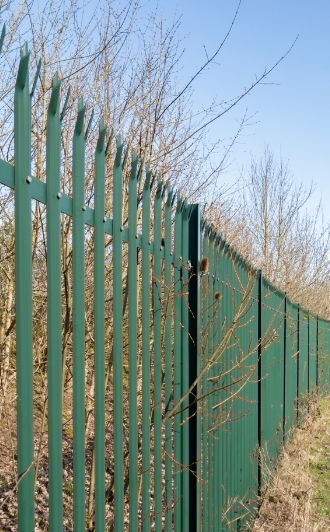
Safety and palisade fencing is the steel perimeter that goes...
More Details
Areas We Serve
- Speed Humps Amberley
- Speed Humps Ashburton
- Speed Humps Christchurch
- Speed Humps Darfield
- Speed Humps Kaiapoi
- Speed Humps Methven
- Speed Humps Rangiora
- Speed Humps Rolleston
- Speed Humps Timaru
Other Services Available in Amberley
- Automatic Gates Amberley
- Bollards Amberley
- Commercial Gates Amberley
- Convex Safety Mirrors Amberley
- Custom Gates Amberley
- Driveway Gates Amberley
- Gate Access Systems Amberley
- Industrial Gates Amberley
- Line Marking Amberley
- Safety and Palisade Fencing Amberley
- Security Gates Amberley
- Wheel Stops Amberley
Questions from North Canterbury
Where should a speed hump go?
Where the speed actually is, which is usually a short way past the entrance rather than at it, and never on top of a parking bay, a loading position or a drainage line. We walk the route a driver takes before recommending a spot.
What are the downsides?
Noise and vibration where heavy vehicles cross, wear on suspension, slower emergency access, and complaints when the profile is too sharp for the traffic. Every one of those is a design decision rather than an inevitability.
What is the difference between a speed bump and a hump?
The words are used interchangeably. Where a line is drawn, a bump is short and abrupt, a hump longer and gentler, and neither is a specification.
How fast should I go over one?
At the speed the device was built for. The posted limit for the road still applies regardless.
Can I get a hump on the highway outside my property?
No. State Highway 1 is NZTA’s road, and the change under way there is a proposed limit reduction. Your own entrance and yard are a separate matter, and they are yours.
Ours were put in too high. Can they be fixed?
Sometimes, depending on how they were built. A bolt-down unit can be swapped for a different profile. A formed hump means cutting, which is what happened at Leithfield Beach, so it is worth getting right at the start.
Get Started with Professional Line Marking Solutions

Get a Free Consultation
Speak with our experts to discuss your line marking requirements and get a tailored solution.
Schedule Now
Need Help Choosing?
Our team provides advice on the right line marking services and materials for your site.
Find Your Solution
Talk to an Expert
Have questions or want a quote? Connect with our experienced team today.
Contact Us