 Available 24 Hours a Day, 7 Days A Week
  027 424 0600

Speed Humps Rangiora

Available 24 Hours a Day, 7 Days A Week

100% Client Satisfaction

Full Range of Premier Services

High-Quality Products
Get A Free Quote

Most people searching for speed humps in Rangiora have a school gate in mind, or a driveway somebody treats as a straight. A hump is a raised profile across a lane, formed in the surface or bolted onto it, shaped so that crossing at speed is uncomfortable. You find them on treated residential streets, at crossing points, and inside private car parks, yards and accessways. Who decides comes down to who owns the ground. On a public Rangiora street it is Waimakariri District Council, which weighs traffic and safety evidence rather than counting requests. On your own site it is you, and nothing has to be approved. Group One New Zealand designs, manufactures and installs traffic calming, with crews travelling up from Foremans Road in Islington, Christchurch. Sydney Chappell founded the New Zealand company in 2026.
The humps on Southbrook Road, and why they are there
Waimakariri District Council planning documents record five speed humps on Southbrook Road as part of road safety improvements near schools. That is the most specific street-level installation record in North Canterbury, and it is not a coincidence that it sits by a school. Vertical deflection is what road authorities reach for first around school gates, because a sign asks and a hump insists.
It is worth knowing how differently the same council has treated other streets. In Kaiapoi, humps have been respaced after resident feedback and, on one boulevard, supported for removal over noise and vibration. Rangiora is where they went in for the children; Kaiapoi is where they were argued over. Same authority, same district, opposite outcomes, which tells you the assessment is genuinely case by case.
Call 027 424 0600 to Request a Free Quote
Industries We Serve
We proudly serve clients across a range of sectors, including:

Hospitals

Aviation Surfaces

Schools

Sporting Surfaces

Factory Safety Lines

Body Corporate

The street belongs to the council. The car park does not.
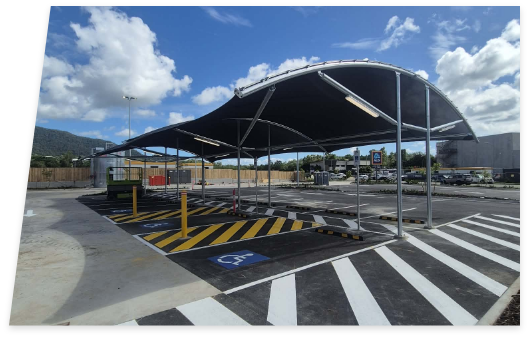
Cross your boundary and the rules change owner. Out on the road, Waimakariri District Council decides, on its own evidence and its own programme, and your route is a request to the council rather than a job you can book. Inside the boundary, the decision sits with whoever owns or manages the land. A school car park, a preschool drop-off loop, a commercial forecourt, a body corporate accessway, a farm entrance: the owner picks whether a hump goes in, where it sits and what it is made of. Where the accessway is closed off with , the gate is where a driver’s run through the site starts, so the measure-up starts there too. That is where we come in.
The school gate is a car park problem before it is a road problem
Ask any school office and the trouble is concentrated in twenty minutes, twice a day. Parents queue, children step out between parked cars, and someone always cuts through the staff car park to escape the line. Two of those three happen on ground the school controls.
On the school’s own surface you can do quite a lot without asking anybody. A hump across the entrance approach stops the run-up before it starts. A raised table at the point children actually cross puts them at kerb level instead of stepping down into moving traffic. Marking and signage make the drop-off loop one-way and obvious. All of it can be done in a single visit during a break.

Picking the device
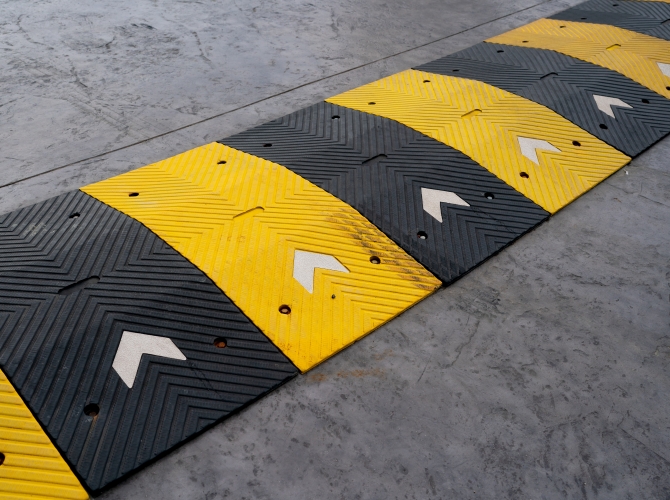
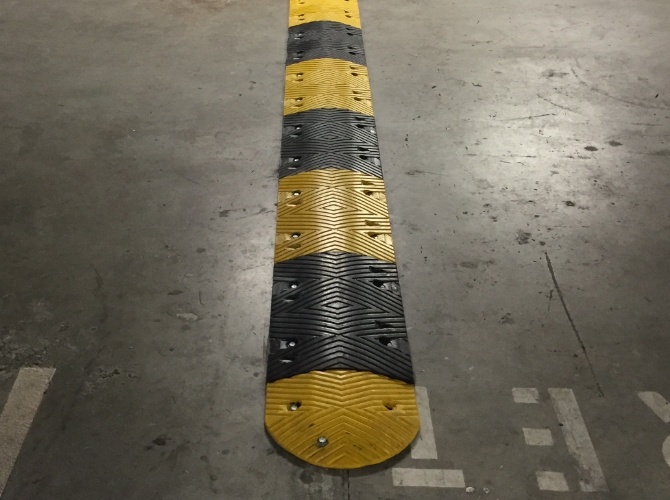
Full-width humps suit car park aisles and entrance approaches where every vehicle should slow. Speed cushions leave room for wide-axle vehicles to straddle, which matters where buses or trucks use the same route. Raised tables and raised pedestrian crossings lift the surface where people cross on foot. Modular rubber and bolt-down units fix onto sound asphalt or concrete without reforming it. Deployable units cover events, works and temporary layouts. Asphalt or concrete profiles formed in place are the permanent answer when the surface is being built or resealed anyway.
Rangiora is still being built, which is the cheapest time to do this
The Waimakariri District Plan unlocked land for up to 17,000 new houses across Rangiora, Kaiapoi, Woodend and Oxford, with sections running from about 330 m² to 1127 m² alongside duplex and townhouse options, and 7,458 businesses now trade across the district. Every one of those developments produces a new accessway, forecourt or car park that nobody has driven yet.
Calming built in while the surface is being formed costs less and looks like it belongs. Retrofitted after the first near-miss, it is a bolt-down unit on a finished slab, which works perfectly well but was never the cheap option.
Need Professional Line Marking or Safety Products?
Contact Group One today – reliable, accredited, and available 24/7.

Client Testimonials


5.0 Stars / 21 + reviews
The team from Group One were exceptional.
They arrived on time, did a fantastic job and made our childcare centre carpark look like new . Thankyou
Prompt and efficient service.
Very professional and experienced. Syd always answers his phone otherwise calls you back. Highly recommended.
Highly recommended.
Competitive price, quality work and even helped me put up the customer parking signs. Went above and beyond. Thanks very much, Syd and Blake.
Great job and no complaints!
Wonderful to work with and helping us get our line marking completed. Would definitely use again and refer to others.
Highly Recommend Group 1 Linemarking!
We recently hired Group 1 Linemarking for a few of our residential strata projects, and the results exceeded our expectations. The team was punctual, professional, and clearly experienced. The line marking was crisp, precise, and done exactly to spec. Communication throughout the process was smooth, and they were flexible with scheduling, which made things a lot easier on our end. If you need reliable, high-quality line marking services, I wouldn’t hesitate to recommend Group 1. Great job!
Working with Syd and his team is always a pleasure
The quality of work is always to a high standard. The Group One team is always professional, they apply a high standard for safety ensuring their SWMS is tailored for the job and their equipment is serviced and well maintained. I highly recommend Group One and if you use them you won’t be disappointed.
What the quote depends on, and how we work
Pricing is on quote. The number follows the device and the quantity, the surface it fixes into or is formed onto, site access and when the area can be handed over, the traffic volumes and vehicle types crossing it, drainage, the marking and signage around it, and any reinstatement needed afterwards.
We work in three stages: design, manufacture and installation. Design means a site visit and a measure-up, standing where the speed actually builds rather than where a hump would look tidy on a plan. Manufacture covers the unit or profile for that layout. Installation includes making the surface good and marking the hump so drivers see it in time.
Group One New Zealand, and who you would be dealing with
On a page about school-area safety it is worth admitting that the company is younger than the five humps on Southbrook Road: Sydney Chappell founded Group One New Zealand in 2026. It is a small team, reaching Rangiora from Islington in Christchurch, and it has no role at all on the public street, which is Waimakariri District Council’s. Where it does have one is inside the gate: the school car park, the church forecourt, the body-corporate accessway being formed in a new subdivision this year. Whatever depth there is sits in Australia, by the company’s own account: “Although Group 1 Line Marking has just started here in New Zealand, as a group we have been operating in Australia for almost 25 years.” The page sets out the devices.
Call 027 424 0600 to Request a Free Quote




Book it for the holidays
School grounds are the one site where timing decides everything. An empty car park over a term break gives a crew clear run of the surface, curing time before the first drop-off, and marking that is dry and visible on day one of term. If that is your site, work backwards from the break rather than the budget round.
Phone us on 027 424 0600 or email info@groupone.co.nz, 7am to 3pm Monday to Friday. Group One New Zealand, Unit 1, 37 Foremans Road, Islington, Christchurch 8042. NZBN 9429053752833.
Call 027 424 0600 to Request a Free Quote
Comprehensive Line Marking & Safety Services
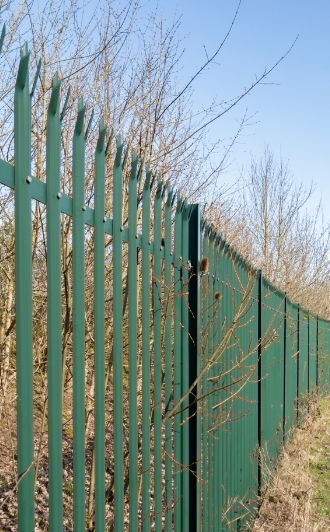
Safety and Palisade Fencing
Safety and palisade fencing is the steel perimeter that goes...
More Details
Areas We Serve
- Speed Humps Amberley
- Speed Humps Ashburton
- Speed Humps Christchurch
- Speed Humps Darfield
- Speed Humps Kaiapoi
- Speed Humps Methven
- Speed Humps Rangiora
- Speed Humps Rolleston
- Speed Humps Timaru
Other Services Available in Rangiora
- Automatic Gates Rangiora
- Bollards Rangiora
- Commercial Gates Rangiora
- Convex Safety Mirrors Rangiora
- Custom Gates Rangiora
- Driveway Gates Rangiora
- Gate Access Systems Rangiora
- Industrial Gates Rangiora
- Line Marking Rangiora
- Safety and Palisade Fencing Rangiora
- Security Gates Rangiora
- Wheel Stops Rangiora
What Rangiora sites ask us
Can a school put in speed humps without council approval?
On the school’s own grounds and car park, yes. The board or the property manager decides. Anything in the road corridor outside the gate is Waimakariri District Council’s call.
What is the maximum height a speed hump can be?
There is no single figure we will quote you for a public road, because that sits with the road controlling authority. Ask Waimakariri District Council for a street. On a private site the profile is selected for the vehicles crossing it, and we specify it as part of the design.
What is the difference between a speed bump and a hump?
Everyday speech treats them as the same thing. Where a line is drawn, a bump is short and abrupt and a hump is longer and gentler. Neither word is a standard, so the profile matters more than the label.
What are they called in New Zealand?
Judder bars, usually.
How fast can you go over one?
The posted limit still applies, and the device is shaped so that anything above the speed it was built for feels wrong.
Can it go in on a new subdivision accessway before handover?
Yes, and that is the easiest version of this job. Tell us at the design stage and the calming is formed with the surface rather than added to it.
Get Started with Professional Line Marking Solutions

Get a Free Consultation
Speak with our experts to discuss your line marking requirements and get a tailored solution.
Schedule Now
Need Help Choosing?
Our team provides advice on the right line marking services and materials for your site.
Find Your Solution
Talk to an Expert
Have questions or want a quote? Connect with our experienced team today.
Contact Us