 Available 24 Hours a Day, 7 Days A Week
  027 424 0600

Security Gates

Available 24 Hours a Day, 7 Days A Week

100% Client Satisfaction

Full Range of Premier Services

High-Quality Products
Request a Free Quote

Security gates are the gates you fit when the point of the gate is keeping people and vehicles out, not just closing a gap. They go across yard entrances, contractor compounds, depot and warehouse driveways, farm and lifestyle-block frontages, and residential driveways where the owner wants the property genuinely shut rather than symbolically bounded. What separates them from an ordinary gate is not appearance. It is the frame, the way they hang, the ground clearance, the locking, and whether the fence either side is up to the same standard. Group One New Zealand designs, manufactures and installs them from a workshop in Islington, Christchurch.
Two different products share the name
The term covers two things that have almost nothing in common. One is the retractable or expandable grille gate: a concertina of steel that pulls across a shop doorway, a window, a car park entrance or an internal opening, fitted into an existing frame and stored folded to one side. The other is a fabricated perimeter gate: a purpose-built steel or aluminium gate hung on posts across a driveway or yard entrance, forming part of the boundary itself. Both are legitimately called security gates. This page is about the second kind, which is what we build. If your opening is a doorway or a shopfront rather than a boundary, a grille product is the one to price.
Call 027 424 0600 to Request a Free Quote

Swing, sliding or cantilever
For a secure entrance the running gear matters as much as the leaf, and the ground usually makes the decision.
Swing gates hang on posts and need clear ground through the whole arc. On a level entrance with room either side they give the simplest mechanism and the fewest parts to maintain. A pair of leaves suits a wide opening better than a single long one, because a long leaf puts serious load on the hinges every time it moves.
Sliding gates run across the opening on a bottom track. They need run-off space beside the driveway, they cope with slope where a swing gate cannot, and the track has to stay clear to keep working.
Cantilever gates slide as well, but the leaf is carried on rollers set back on the fence line with nothing on the ground. That makes them the answer on a yard that collects gravel, mud, snow or debris, and on entrances too wide for a swing gate to be practical.
Height and infill then follow the fence they sit in. A gate that stops at waist height in a two metre fence is the part of the boundary that does no work, so the gate and the perimeter get specified together. Vertical bar infill is the common choice because it gives nothing useful to stand on, while sheet or slat infill adds privacy at the cost of catching wind.
Security gates Group One New Zealand makes
We build the gate rather than order it in, which is the practical difference on this kind of work: the leaf can be made to the opening, the height matched to your fence, and the hardware chosen for the weight rather than for what came in the kit. Sydney Chappell founded the New Zealand company in 2026, the workshop is at Unit 1, 37 Foremans Road, Islington, Christchurch 8042, and all our gates are 100% New Zealand made and installed. Every gate constructed by our team comes with a comprehensive warranty and is backed by a full after-sales service. We are a small team, so you know you’ll get the very best, and the sites we reach run from Amberley in the north to Timaru in the south and west towards the Canterbury foothills.
For a gate on your entrance, phone us on 027 424 0600 or email info@groupone.co.nz, 7am to 3pm Monday to Friday.
Call 027 424 0600 to Request a Free Quote
Industries We Serve
We proudly serve clients across a range of sectors, including:

Hospitals

Aviation Surfaces

Schools

Sporting Surfaces

Factory Safety Lines

Body Corporate

What actually makes a gate secure
Six things, and none of them is the label on the product:
- Frame section. A gate is a lever. The frame has to resist twist across the full width of the opening without help.
- Posts and footings. Most failures on a heavy gate start in the ground, not in the gate.
- Hinges and rollers. Sized for the leaf weight, and on a swing gate fitted so the leaf cannot simply be lifted off.
- Ground clearance. Enough to run over an uneven surface, no more than that.
- Locking. Mechanical locks, drop bolts, electric strikes or magnetic locks, chosen for how the gate is actually used day to day.
- The fence either side. A gate built to a higher standard than its boundary changes nothing.
Access control is the layer on top: keypads, remotes, intercoms, card readers and free-exit sensors. Our range of parts, hardware, access controllers and remote locks covers the hardware side of that, and how it goes onto a gate you already own sits on the gate access systems page.
Designed, built and hung
Design begins at the entrance. We’ll come out and take a look at the site and discuss ideas with you about the best solution for your situation: the opening width, the fall across it, the fence height either side, where a leaf can travel, and how the gate needs to behave for the traffic that uses it.
Manufacture is the workshop stage, where the frame, infill, posts and hardware are built and finished to those measurements. Our range of materials covers wood, steel, aluminium and stainless steel, so the gate can match a fence line or a building rather than sit against it.
Installation is footings, posts, hanging the leaf, fitting the locks and setting everything to close properly. If the gate is being automated, the operator and safety devices go on at the same visit rather than later.
Call 027 424 0600 to Request a Free Quote

What a quote follows
Pricing is on quote. What moves it: the opening width, single leaf or pair, swing against sliding or cantilever, the height and infill, the material and finish, the locking and access hardware, the ground the posts go into, and whether an existing gate has to come out first.
Local pages for security gates
Security gate work is covered across the region:
- Security Gates Amberley
- Security Gates Ashburton
- Security Gates Christchurch
- Security Gates Darfield
- Security Gates Kaiapoi
- Security Gates Methven
- Security Gates Rangiora
- Security Gates Rolleston
Start with the opening
One question decides the whole product, and it is worth answering before anything gets priced: is the opening part of your boundary, or part of a building. A boundary opening wants a fabricated gate, posts in the ground and a fence that matches it. A doorway or shopfront opening is a different trade with different hardware. Sites regularly have both, and they get quoted as two separate pieces of work rather than one.
Phone us on 027 424 0600 or email info@groupone.co.nz, 7am to 3pm Monday to Friday. Group One New Zealand, Unit 1, 37 Foremans Road, Islington, Christchurch 8042. NZBN 9429053752833.
Call 027 424 0600 to Request a Free Quote
Need Professional Line Marking or Safety Products?
Contact Group One today – reliable, accredited, and available 24/7.

Client Testimonials


5.0 Stars / 21 + reviews
The team from Group One were exceptional.
They arrived on time, did a fantastic job and made our childcare centre carpark look like new . Thankyou
Prompt and efficient service.
Very professional and experienced. Syd always answers his phone otherwise calls you back. Highly recommended.
Highly recommended.
Competitive price, quality work and even helped me put up the customer parking signs. Went above and beyond. Thanks very much, Syd and Blake.
Great job and no complaints!
Wonderful to work with and helping us get our line marking completed. Would definitely use again and refer to others.
Highly Recommend Group 1 Linemarking!
We recently hired Group 1 Linemarking for a few of our residential strata projects, and the results exceeded our expectations. The team was punctual, professional, and clearly experienced. The line marking was crisp, precise, and done exactly to spec. Communication throughout the process was smooth, and they were flexible with scheduling, which made things a lot easier on our end. If you need reliable, high-quality line marking services, I wouldn’t hesitate to recommend Group 1. Great job!
Working with Syd and his team is always a pleasure
The quality of work is always to a high standard. The Group One team is always professional, they apply a high standard for safety ensuring their SWMS is tailored for the job and their equipment is serviced and well maintained. I highly recommend Group One and if you use them you won't be disappointed.
Questions people ask
Can a security gate be automated later?
Yes, and it is far cheaper if the gate was built for it. Post size, leaf weight and a conduit run are the decisions that matter, and they are all made at design stage.
What locks do you fit?
Whatever suits how the gate gets used. A yard gate opened by staff several times a day wants different hardware from a rural entrance locked for weeks at a time.
Do you make matching pedestrian gates?
Yes. Ordering the vehicle gate and the side gate together keeps the frontage consistent and saves a second visit.
Will a security gate match our existing fence?
Usually. Bring photos and the fence dimensions to the site visit and the gate gets built to that profile and finish.
Do you work on farm and rural entrances?
Yes. Long spans, uneven ground and no mains power at the gate are all normal conditions rather than exceptions.
Comprehensive Line Marking & Safety Services
Safety and Palisade Fencing
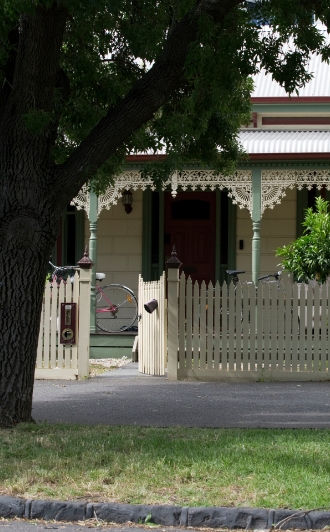
Safety and palisade fencing is the steel perimeter that goes...
More Details
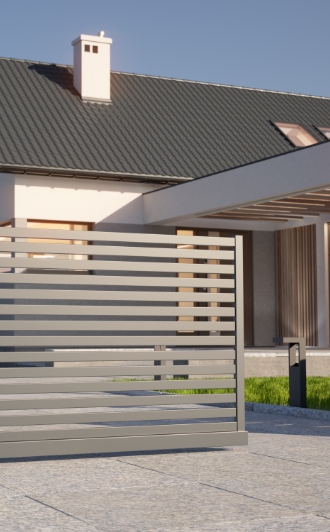
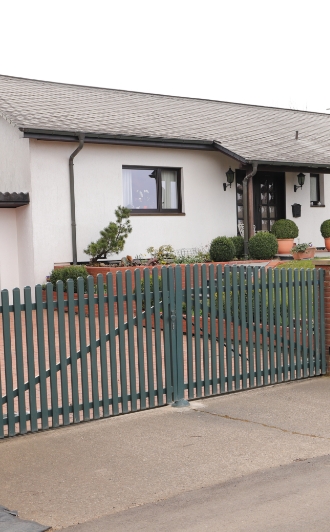
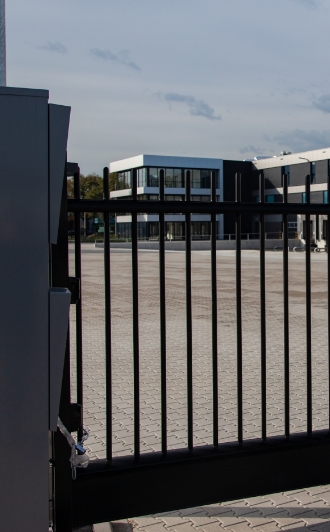
Sliding and Electric Gates
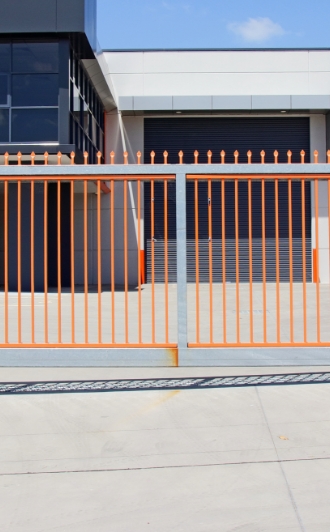
Group One provides professional sliding and electric gate solutions...
More Details
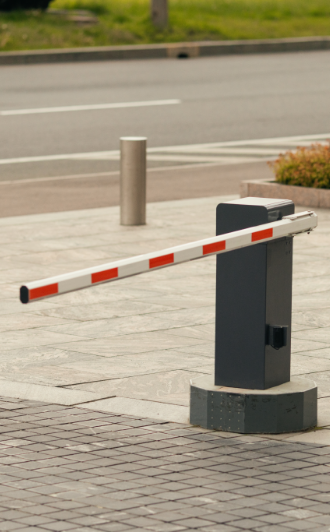
Barrier Arms & Boom Gates
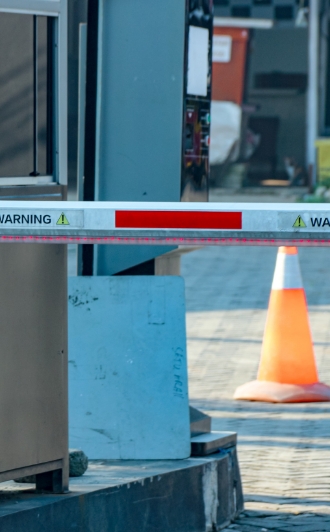
Control vehicle access with reliable barrier arm and boom gate...
More Details
Get Started with Professional Line Marking Solutions

Get a Free Consultation
Speak with our experts to discuss your line marking requirements and get a tailored solution.
Schedule Now
Need Help Choosing?
Our team provides advice on the right line marking services and materials for your site.
Find Your Solution
Talk to an Expert
Have questions or want a quote? Connect with our experienced team today.
Contact Us